Skip to content

Execution Platform

Training

Unified data, services, workflows and agents in one operating substrate.

Training is part of the Advanze platform layer: the execution foundation that enables applications, services and AI agents to work as one operating system for the business. It is designed for extensibility, governance and scale from the start.

People operations team coordinating employee lifecycle and access governance.
Training starts with people trying to make the right call. A new employee needs accounts, equipment and onboarding tasks.

Execution Platform / Training

Built as an execution foundation

Advanze is positioned around the idea that enterprise software must evolve from passive systems of record into active systems of execution. In that model, this page is not just a feature description. It explains how Training contributes to an operating environment where people define intent, agents execute governed work, and leadership can see progress through unified data.

The value is strongest when the capability is connected to adjacent processes. Records, workflows, controls, communications and analytics should not live in separate tools. They should participate in a shared execution fabric that can coordinate work across departments while preserving human accountability.

People operations team coordinating employee lifecycle and access governance.
Where Training becomes real work people can trust. Employee lifecycle, access and workforce work coordinated across people, systems and approvals.

Core capabilities

What Training enables

Each capability is designed to work as part of the broader execution platform rather than as a disconnected module.

Interactive Learning Modules

Self-paced training courses with video tutorials, quizzes and hands-on exercises. Agents track progress, recommend next steps and adapt content based on learner performance. Gamification elements encourage engagement and knowledge retention.

Role-Based Learning Paths

Curated training programs tailored to specific roles, industries and proficiency levels. Agents assess current skills, identify gaps and build personalized learning roadmaps. Certification tracks validate competency and credential learners upon completion.

Hands-On Practice Environments

Sandbox environments provide risk-free practice with platform features using realistic datasets. Guided exercises walk learners through common workflows with step-by-step instructions. Agents provide hints, validate actions and offer corrective feedback in real-time.

Collaborative Learning

Discussion forums, peer mentoring and study groups foster collaborative learning communities. Agents facilitate connections between learners, surface relevant discussions and highlight best practices. Expert Q&A sessions provide direct access to product specialists.

Competency Assessment

Skills assessments measure proficiency across platform capabilities with role-specific scenarios. Agents analyze performance, identify knowledge gaps and recommend targeted remediation. Certification exams validate enterprise-level competency with proctored testing.

Learning Analytics

Dashboards track learning progress, completion rates and assessment scores across user populations. Agents identify struggling learners, predict dropout risk and trigger intervention workflows. Analytics inform content improvements and training program effectiveness.

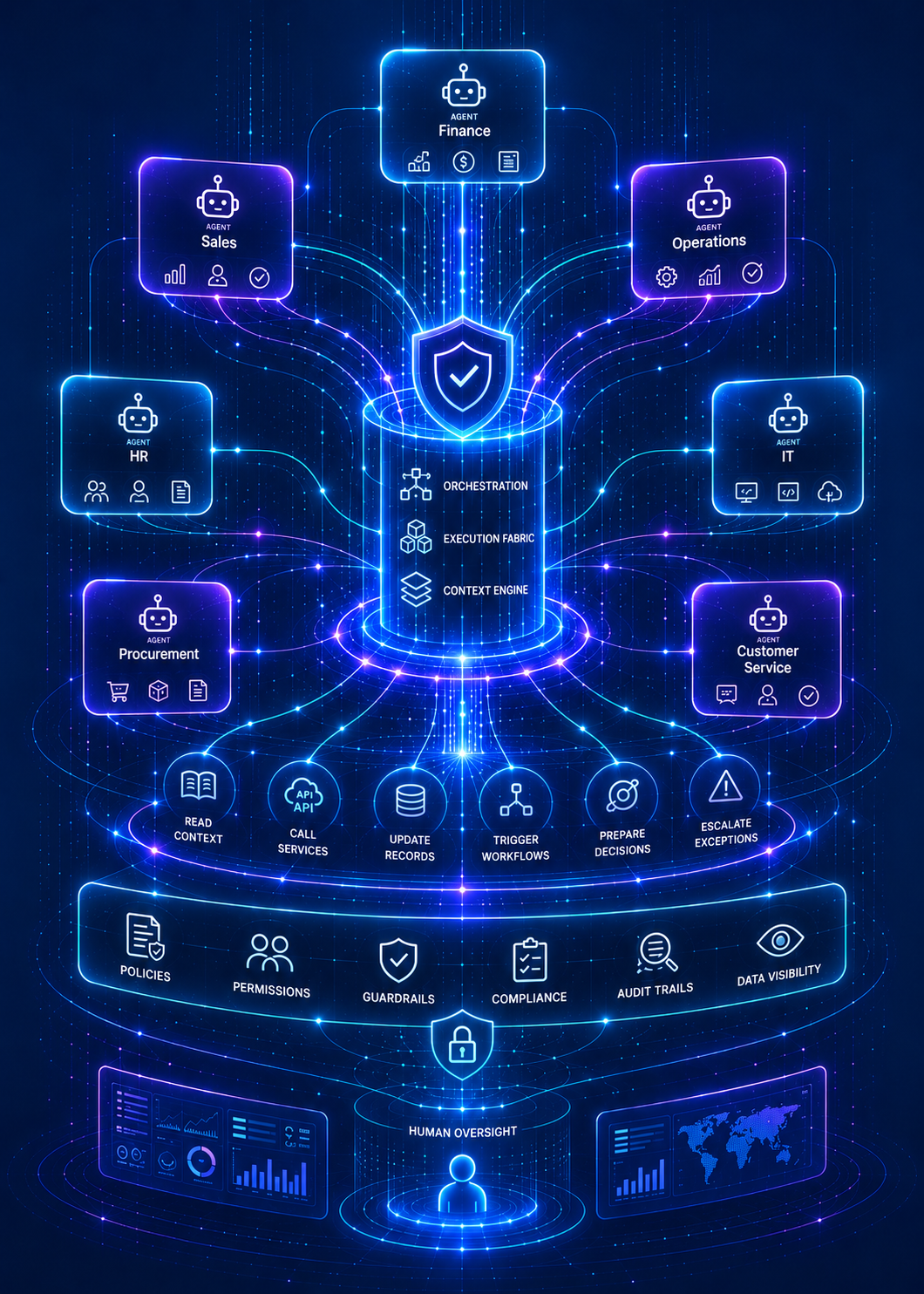
The Advanze Control Model - AI Agents Execute Work Inside the Control Model

Agentic operating model

AI agents execute work inside the control model

Advanze treats AI agents as participants in the operating model. Agents can read context, call services, update records, trigger workflows, prepare decisions and escalate exceptions. Human teams remain responsible for judgement, governance and business accountability.

That distinction matters. The goal is not to add another chatbot to existing systems. The goal is to create an execution platform where work can move across functions with consistent permissions, policies, audit trails and data visibility.

Business outcomes

What becomes possible

Scale by designArchitecture supports growing workloads, data and agent activity.
Governed automationSecurity, identity and controls are embedded in execution paths.
Composable servicesTeams can build faster using reusable platform capabilities.
Operational confidenceTelemetry and auditability make execution observable.
People operations team coordinating employee lifecycle and access governance.
The outcome is not just automation. It is confidence in what happens next. When Training runs inside a governed execution model, teams can move faster without losing judgement, accountability or trust.

Agentic use case

Where Training becomes governed execution.

A new employee needs accounts, equipment and onboarding tasks.

What makes it harder in the real world: Onboarding touches identity, role-based permissions, manager approvals, equipment, policy acknowledgements, payroll, training, compliance and removal of excess access.

What Advanze changes: Coordinate new hire onboarding across HR, IT, security, facilities, finance and managers with controlled access provisioning and evidence.

HR Onboarding AgentCreates onboarding plan, collects required information and coordinates HR tasks.
Access AgentMaps role, department and location to required access packages.
Security AgentChecks least privilege, MFA, policy acknowledgements and risk exceptions.
IT Provisioning AgentCreates approved tasks for device, account and application provisioning.
Manager ReviewerApproves role-specific access and confirms readiness.
Challenge

Onboarding touches identity, role-based permissions, manager approvals, equipment, policy acknowledgements, payroll, training, compliance and removal of excess access.

Orchestration

Coordinate new hire onboarding across HR, IT, security, facilities, finance and managers with controlled access provisioning and evidence.

Success

Coordinate new hire onboarding across HR, IT, security, facilities, finance and managers with controlled access provisioning and evidence.

People operations team coordinating employee lifecycle and access governance.
People operations 13Employee lifecycle, access and workforce work coordinated across people, systems and approvals.
People operations team coordinating employee lifecycle and access governance.
People operations 14Employee lifecycle, access and workforce work coordinated across people, systems and approvals.
People operations team coordinating employee lifecycle and access governance.
People operations 15Employee lifecycle, access and workforce work coordinated across people, systems and approvals.

Why AI execution needs architecture

The work needs context, controls and clear permissions before automation can safely act.

That is why the Advanze control model matters: identity, permissions, policies, workflow, audit evidence and human judgement are embedded into execution before agents act.

  • Onboarding touches identity, role-based permissions, manager approvals, equipment, policy acknowledgements, payroll, training, compliance and removal of excess access.
  • The right agent must receive the right context, tools, permissions and approval path before work moves forward.
  • Audit evidence, exception handling and human judgement need to be part of the workflow, not notes added after the fact.

Implementation path

How to move from concept to production

Advanze can be introduced progressively. The recommended path is to start with a visible workflow, prove the operating model, then expand into adjacent capabilities as the platform foundation matures.

  1. 1
    Assess the current operating model

    Map the workflows, systems, data sources and manual coordination points around this capability.

  2. 2
    Design the target execution flow

    Define the data model, human approvals, agent tasks, service calls and governance controls.

  3. 3
    Launch a focused implementation wave

    Start with a bounded use case that proves the operating pattern and creates reusable platform assets.

  4. 4
    Scale across the business

    Extend the pattern to adjacent workflows, more agents, more users and deeper integrations.

Next step

Build this into your execution platform roadmap

Explore how Training can be implemented as part of a broader Advanze platform adoption programme, from first pilot to enterprise scale.