From manual coordination to measurable execution outcomes.
Communication focuses on a business outcome rather than a software module. Advanze helps organisations move beyond manual coordination by giving teams, systems and AI agents one shared execution platform.
Communication starts with people trying to make the right call.It starts with one message in a busy inbox. Someone needs to answer quickly, but they also need to know whether the wording creates a promise, exposes sensitive data, misses a complaint trigger, changes a price, or leaves the organisation carrying risk no one has seen.
Business Objective / Communication
Move from coordination effort to governed execution
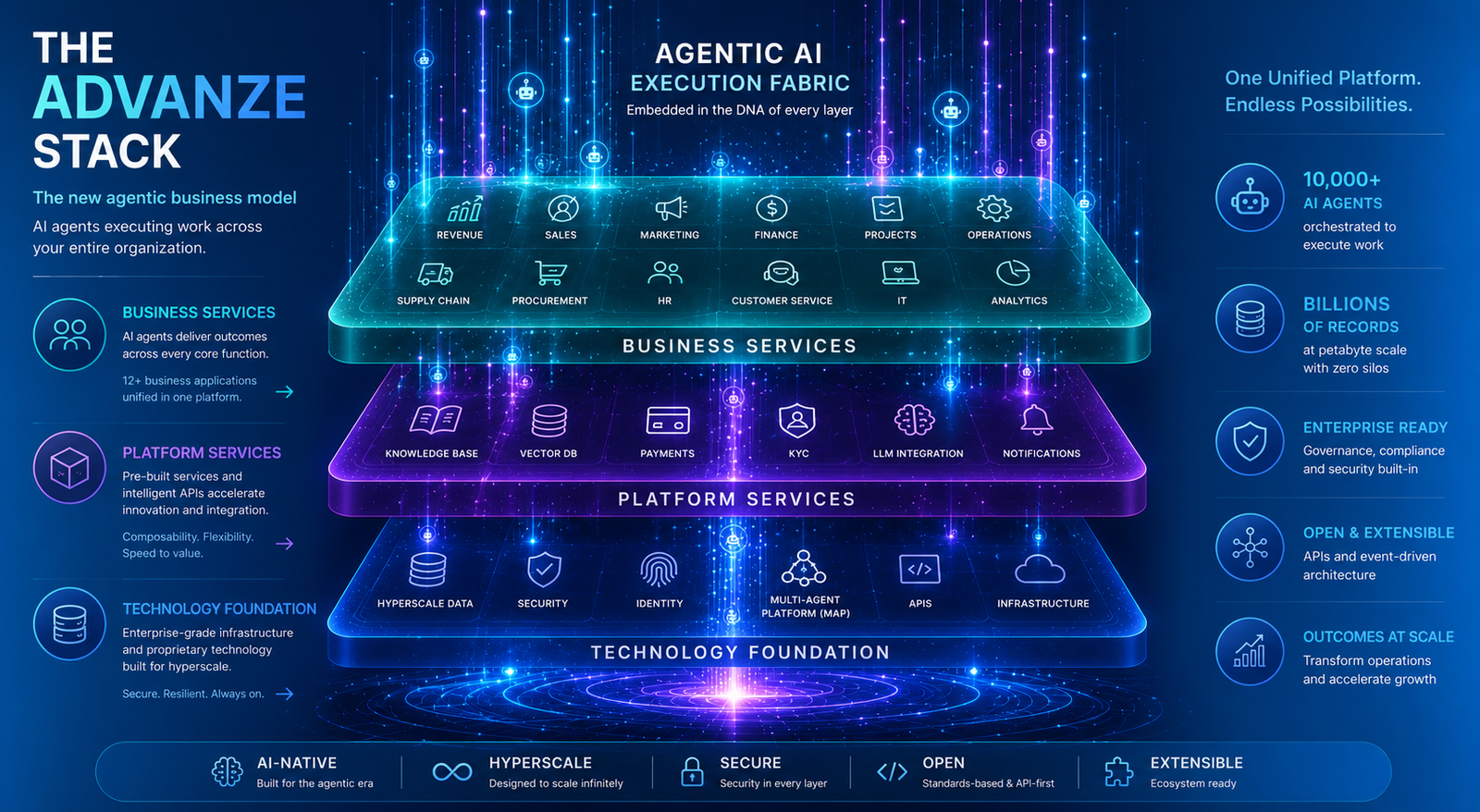
Advanze is positioned around the idea that enterprise software must evolve from passive systems of record into active systems of execution. In that model, this page is not just a feature description. It explains how Communication contributes to an operating environment where people define intent, agents execute governed work, and leadership can see progress through unified data.
The value is strongest when the capability is connected to adjacent processes. Records, workflows, controls, communications and analytics should not live in separate tools. They should participate in a shared execution fabric that can coordinate work across departments while preserving human accountability.
Where Communication becomes real work people can trust.The person responding is no longer alone with the pressure. Agents gather the facts, specialists check the risk, approvals are routed where judgement matters, and the business gets a response it can stand behind.
Core capabilities
What Communication enables
Each capability is designed to work as part of the broader execution platform rather than as a disconnected module.
Unified Messaging Infrastructure
Enterprise messaging platform with channels, direct messages, threads, and file sharing. Replace Slack and Teams with integrated communication tied directly to projects, tasks, customers, and workflows. Context follows conversations automatically.
Transactional Email Engine
Send notifications, approvals, alerts, and customer communications via high-volume email API. Track delivery, opens, clicks, and conversions. Connect email events back to business processes and customer records without third-party tools.
Multi-Channel Notifications
Deliver messages via email, SMS, WhatsApp, push notifications, or in-app alerts based on urgency and user preference. Ensure critical communications reach stakeholders even when they are offline or mobile. Track acknowledgment and response.
AI Communication Agents
Deploy agents to summarize threads, route inquiries, draft responses, translate messages, and notify stakeholders when action is needed. Reduce communication overhead while improving response quality and consistency across teams.
Secure Collaboration
Enterprise-grade encryption, data residency controls, and compliance audit trails built-in. Share sensitive information with customers, partners, and regulators without email attachments or third-party file transfer services. Maintain governance and security.
Communication Archives
Automatic archival of all messages, notifications, and collaboration activity with full-text search and legal hold capabilities. Support eDiscovery, regulatory compliance, and audit requirements without separate archiving systems or manual export processes.
Agentic operating model
AI agents execute work inside the control model
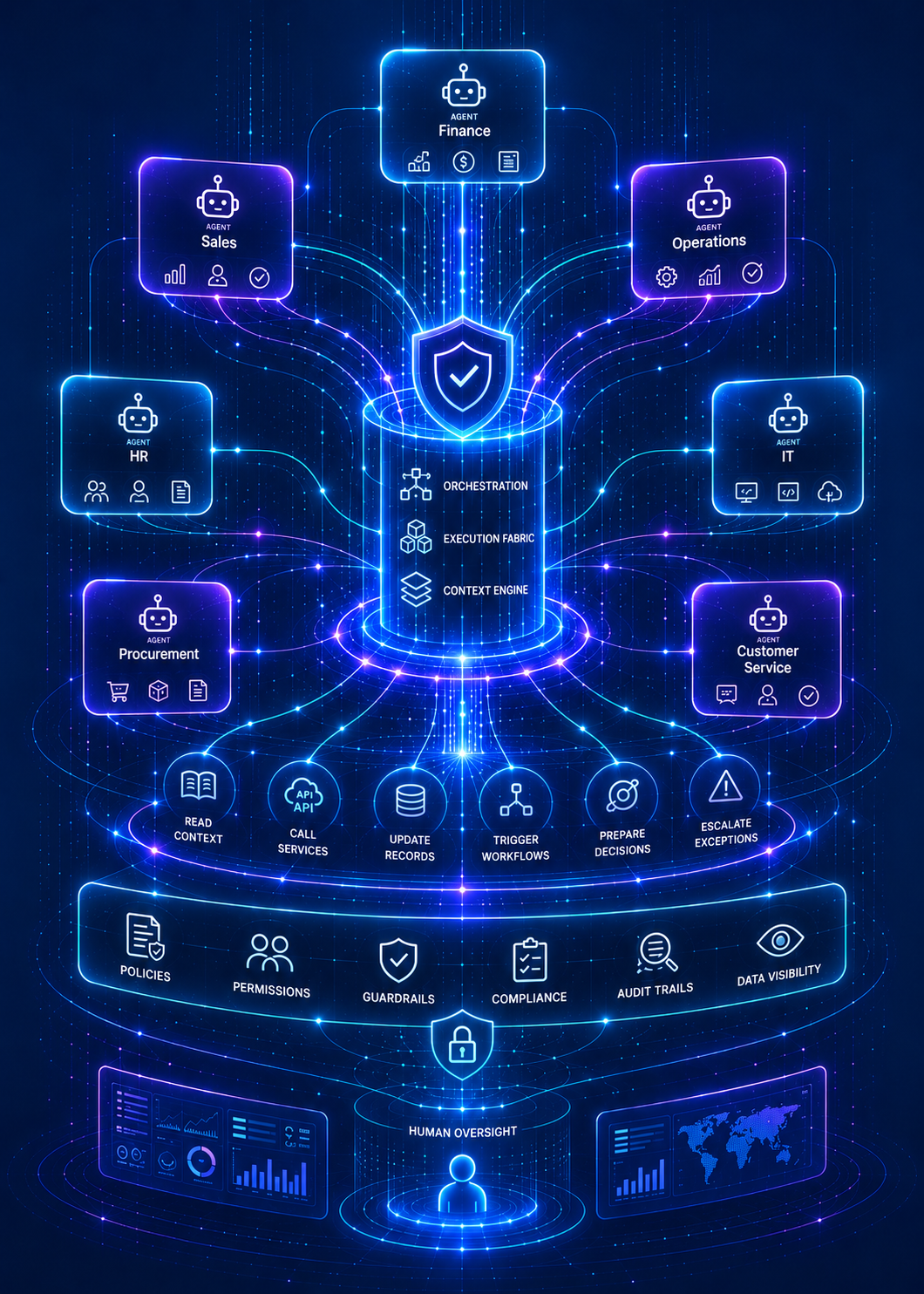
Advanze treats AI agents as participants in the operating model. Agents can read context, call services, update records, trigger workflows, prepare decisions and escalate exceptions. Human teams remain responsible for judgement, governance and business accountability.
That distinction matters. The goal is not to add another chatbot to existing systems. The goal is to create an execution platform where work can move across functions with consistent permissions, policies, audit trails and data visibility.
Business outcomes
What becomes possible
Outcome alignmentTie workflows to measurable business objectives.Execution velocityReduce handoffs, manual follow-up and status chasing.Control and governanceEmbed approvals, policies and audit evidence into work.Data-driven improvementUse unified telemetry to improve continuously.
The outcome is not just automation. It is confidence in what happens next.The person responding is no longer alone with the pressure. Agents gather the facts, specialists check the risk, approvals are routed where judgement matters, and the business gets a response it can stand behind.
Agentic use case
An email is not just an email when it can create risk, cost or commitment.
It starts with one message in a busy inbox. Someone needs to answer quickly, but they also need to know whether the wording creates a promise, exposes sensitive data, misses a complaint trigger, changes a price, or leaves the organisation carrying risk no one has seen.
What the business needs: The email may contain commercial commitments, confidential information, contractual terms, regulated language, payment implications, complaint triggers, legal exposure or security-sensitive attachments. Treating it as a simple drafting task creates operational and compliance risk.
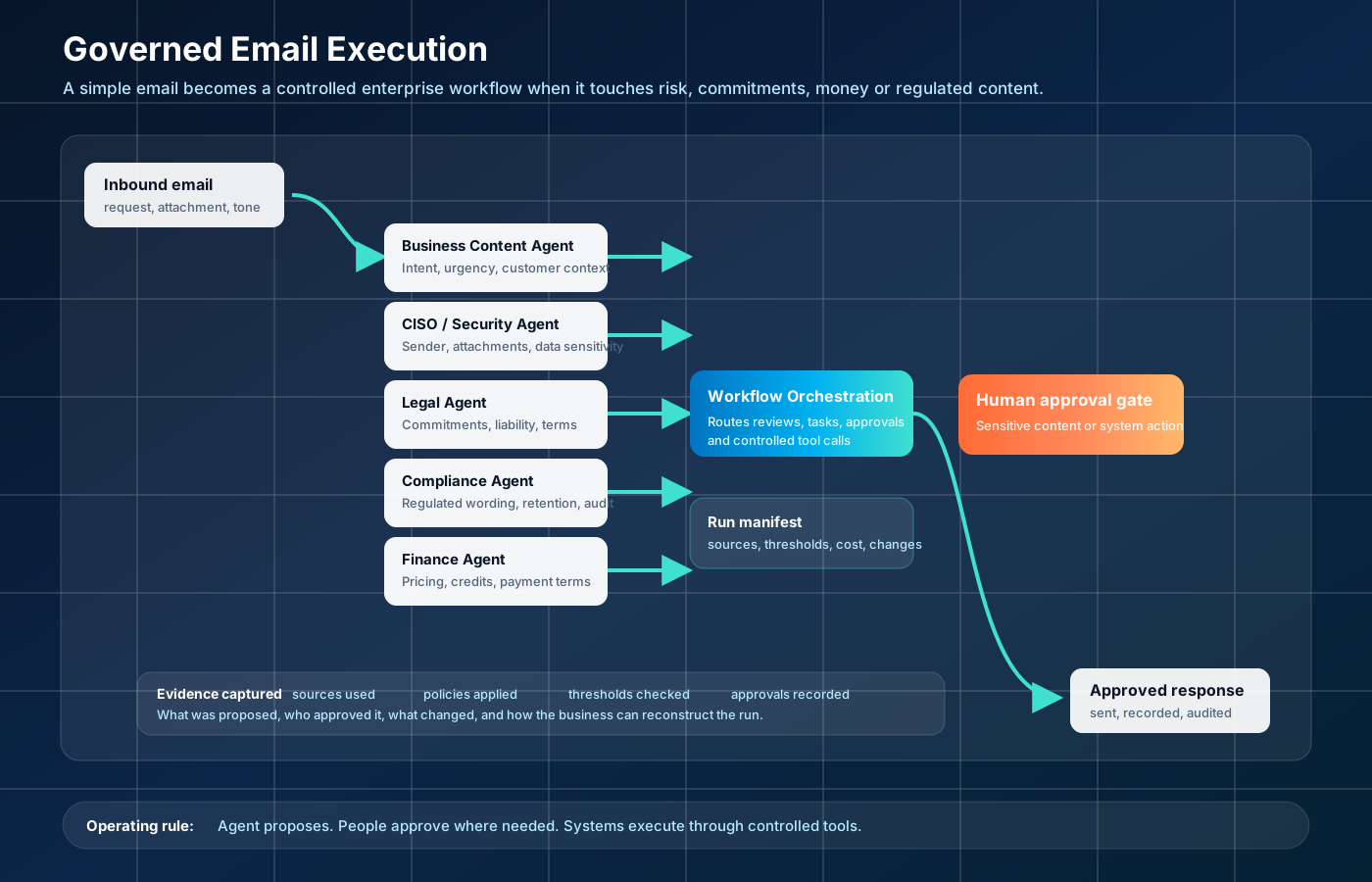
What Advanze changes: Turn an inbound email into a governed execution flow where specialised agents review context, risk, commitments, approvals and next actions before a response or system action is completed.
The person responding is no longer alone with the pressure. Agents gather the facts, specialists check the risk, approvals are routed where judgement matters, and the business gets a response it can stand behind.
Human pressureA service-centre specialist reading a complex customer email on a laptop while a colleague reviews supporting context beside them.Triage realityA shared-service team triaging incoming work in a bright operations room, multiple laptops, calm focus, no readable screens.
Challenge
The inbox is full, the customer is waiting and the answer looks simple. But the message could be an account request, a complaint, a missing-information case, an instruction to move money, a pricing dispute, a legal notice or a security risk.
Orchestration
The classifier agent becomes the first orchestration point in the process. It reads the request, understands the topic and risk, then routes work to the right processing agent and the right guardrail agents before anything important is said or done.
Success
The response is not just faster. It is calmer, safer and more accountable. The organisation knows what was classified, which agents reviewed it, what each agent was allowed to do, who approved the action and what changed in the systems.
Why AI execution needs architecture
Before an agent acts, the platform has to know what kind of work this really is.
This is why Advanze repeats the control model across the site. AI agents can execute work only when the operating model gives them context, identity, permissions, policies, workflow, audit evidence and clear boundaries for human judgement.
The classifier must understand hundreds of possible query types, from account opening and missing information to how-to requests, regulated complaints, payment instructions, fund transfers, invoices and service exceptions.
The processing agent changes by intent. A bank balance request, a support query, a complaint, an invoice dispute and a transfer instruction all need different context, tools, permissions and approval paths.
Guardrail agents protect the process around the processing agent. Personal data, financial exposure, legal commitments, compliance wording, CISO concerns and customer harm all need specialist review.
Permissions matter. Some agents may only read data. Some may draft a response. Some may create a task or update a case. High-impact actions such as transfers, payments, invoices or account changes need explicit tool boundaries and human approval.
The governance framework cannot be bolted on after the AI prompt. It has to be embedded in the architecture of the process: identity, policies, workflow, evidence, approvals, audit logs and controlled execution tools.
Classifier agent
The first job is not answering. The first job is understanding what the request is.
In a shared service centre, one inbox can carry hundreds of query and service types. The classifier decides which processing path, guardrails, permissions and approvals are required.
Open an accountMissing informationHow-to requestComplaint or escalationTransfer fundsPay a billIssue an invoiceChange customer detailsShare sensitive documentsRegulatory or legal noticePricing or credit disputeSecurity concern
Communication execution 1A realistic work scene showing communication, triage, review or customer response under governance.Communication execution 2A realistic work scene showing communication, triage, review or customer response under governance.
Classifier AgentIdentifies topic, intent, urgency, sensitivity, required systems, likely risk and the correct processing path.Business Content AgentUnderstands intent, customer context, urgency, tone, requested outcome and relevant business history.Security and CISO AgentChecks sender risk, attachment risk, data sensitivity, access rights, phishing indicators and information sharing boundaries.Legal AgentReviews commitments, liability language, contractual terms, disclaimers and escalation requirements.Compliance AgentChecks regulated wording, retention obligations, complaint handling rules, approval thresholds and audit requirements.Finance AgentChecks payment terms, pricing, credit notes, invoicing implications, revenue recognition triggers and financial approval thresholds.Workflow Orchestration AgentCoordinates review steps, routes approvals, records evidence and updates the relevant systems once approved.
Technical operating pattern
Classifier, processing agent, guardrails, approval and evidence.
Control model
Agents execute inside the operating model, not around it.
Classifier, processing and guardrail agents are powerful only when they inherit enterprise architecture: identity, permissions, data boundaries, workflow, audit evidence and human approval gates.
Approval boundariesExternal commitments, financial concessions, legal wording, data sharing, payments and system changes pause for review.Audit evidenceSources, policies, thresholds, approvals, cost, actions and system changes are recorded in a run manifest.Tool boundariesRead, draft, update, invoice, pay or transfer rights are granted by role, policy, workflow state and approval status.
Communication execution 3A realistic work scene showing communication, triage, review or customer response under governance.Communication execution 4A realistic work scene showing communication, triage, review or customer response under governance.
Advanze can be introduced progressively. The recommended path is to start with a visible workflow, prove the operating model, then expand into adjacent capabilities as the platform foundation matures.
1
Assess the current operating model
Map the workflows, systems, data sources and manual coordination points around this capability.
2
Design the target execution flow
Define the data model, human approvals, agent tasks, service calls and governance controls.
3
Launch a focused implementation wave
Start with a bounded use case that proves the operating pattern and creates reusable platform assets.
4
Scale across the business
Extend the pattern to adjacent workflows, more agents, more users and deeper integrations.
Next step
Build this into your execution platform roadmap
Explore how Communication can be implemented as part of a broader Advanze platform adoption programme, from first pilot to enterprise scale.