Skip to content

Elevate & Transform

Governance Risk Compliance

From manual coordination to measurable execution outcomes.

Governance Risk Compliance focuses on a business outcome rather than a software module. Advanze helps organisations move beyond manual coordination by giving teams, systems and AI agents one shared execution platform.

Security and governance professionals reviewing operational risk and evidence.
Governance Risk Compliance starts with people trying to make the right call. An incident needs to be logged and resolved.

Business Objective / Governance Risk Compliance

Move from coordination effort to governed execution

Advanze is positioned around the idea that enterprise software must evolve from passive systems of record into active systems of execution. In that model, this page is not just a feature description. It explains how Governance Risk Compliance contributes to an operating environment where people define intent, agents execute governed work, and leadership can see progress through unified data.

The value is strongest when the capability is connected to adjacent processes. Records, workflows, controls, communications and analytics should not live in separate tools. They should participate in a shared execution fabric that can coordinate work across departments while preserving human accountability.

Security and governance professionals reviewing operational risk and evidence.
Where Governance Risk Compliance becomes real work people can trust. Security, compliance and operations teams coordinating response through evidence and approval boundaries.

Core capabilities

What Governance Risk Compliance enables

Each capability is designed to work as part of the broader execution platform rather than as a disconnected module.

Enterprise Risk Register

Centralize risk identification, assessment, and mitigation tracking across all business functions. AI agents continuously scan for emerging risks, score risk exposure using quantitative models, and alert stakeholders when risk thresholds are exceeded or controls fail.

Control Framework Management

Map business processes to control objectives for controls, audit and policy workflows, healthcare controls, and industry frameworks. Automated control testing, evidence collection, and deficiency tracking reduce audit preparation time and provide continuous assurance of control effectiveness.

Policy and Procedure Repository

Maintain versioned policies, procedures, and standards with approval workflows, attestation tracking, and automatic distribution. When policies change, affected users are notified automatically, required training is assigned, and attestation compliance is enforced through the platform.

Incident Management

Track security incidents, operational failures, and compliance breaches through structured incident response workflows. Root cause analysis, corrective actions, and lessons learned are captured systematically, building organizational memory and preventing recurring issues.

Third-Party Risk Assessment

Assess vendor risks through structured due diligence questionnaires, security reviews, and ongoing monitoring. Track vendor compliance certifications, conduct periodic reassessments, and manage vendor lifecycle from onboarding to offboarding with audit-ready documentation.

GRC Reporting and Analytics

Generate compliance reports, risk heatmaps, and control dashboards for board reporting and regulatory submissions. Pre-built templates accelerate reporting while custom analytics enable deep dives into risk trends, control gaps, and remediation progress.

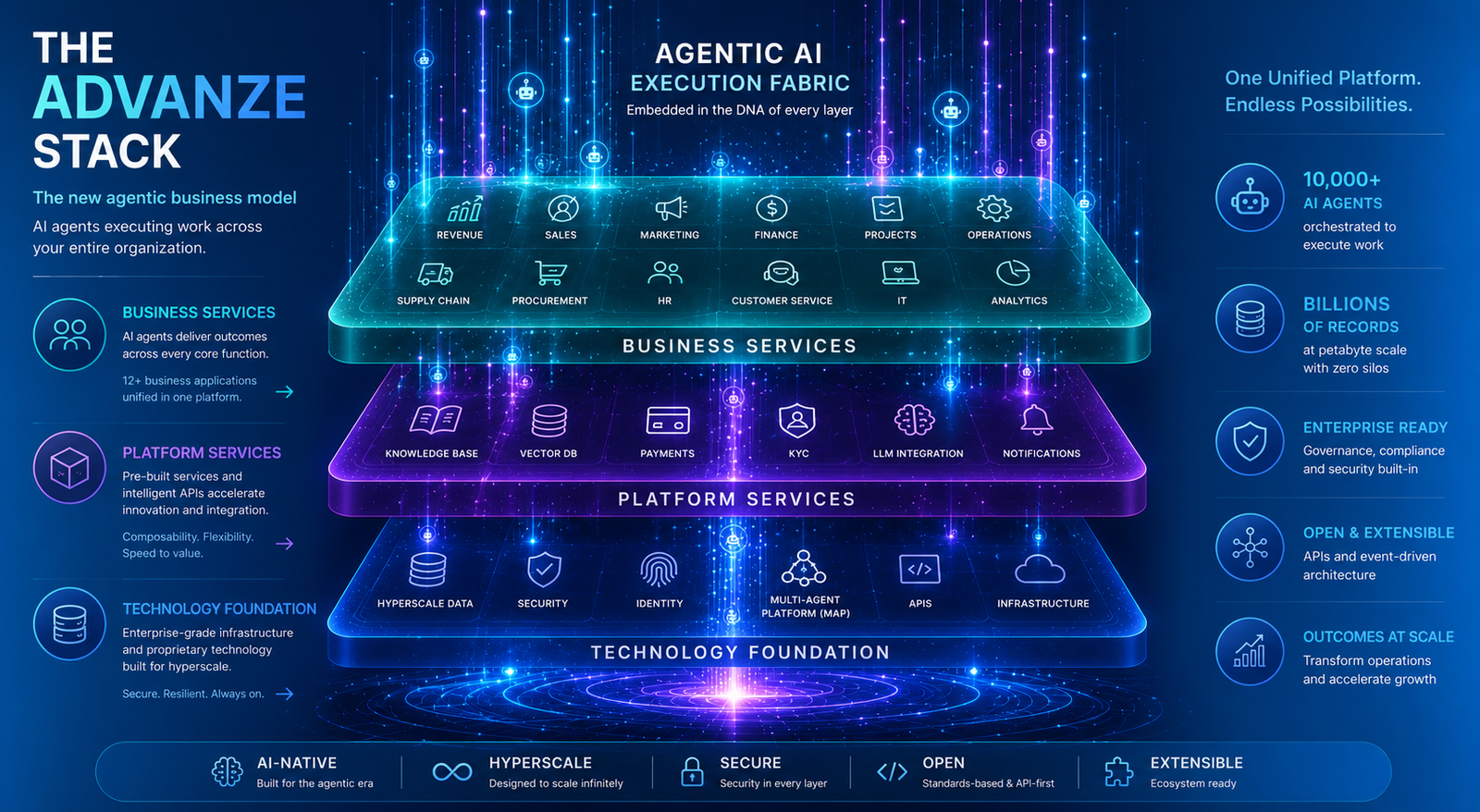
The Advanze Stack - Business Services, Platform Services, Technology Foundation

Agentic operating model

AI agents execute work inside the control model

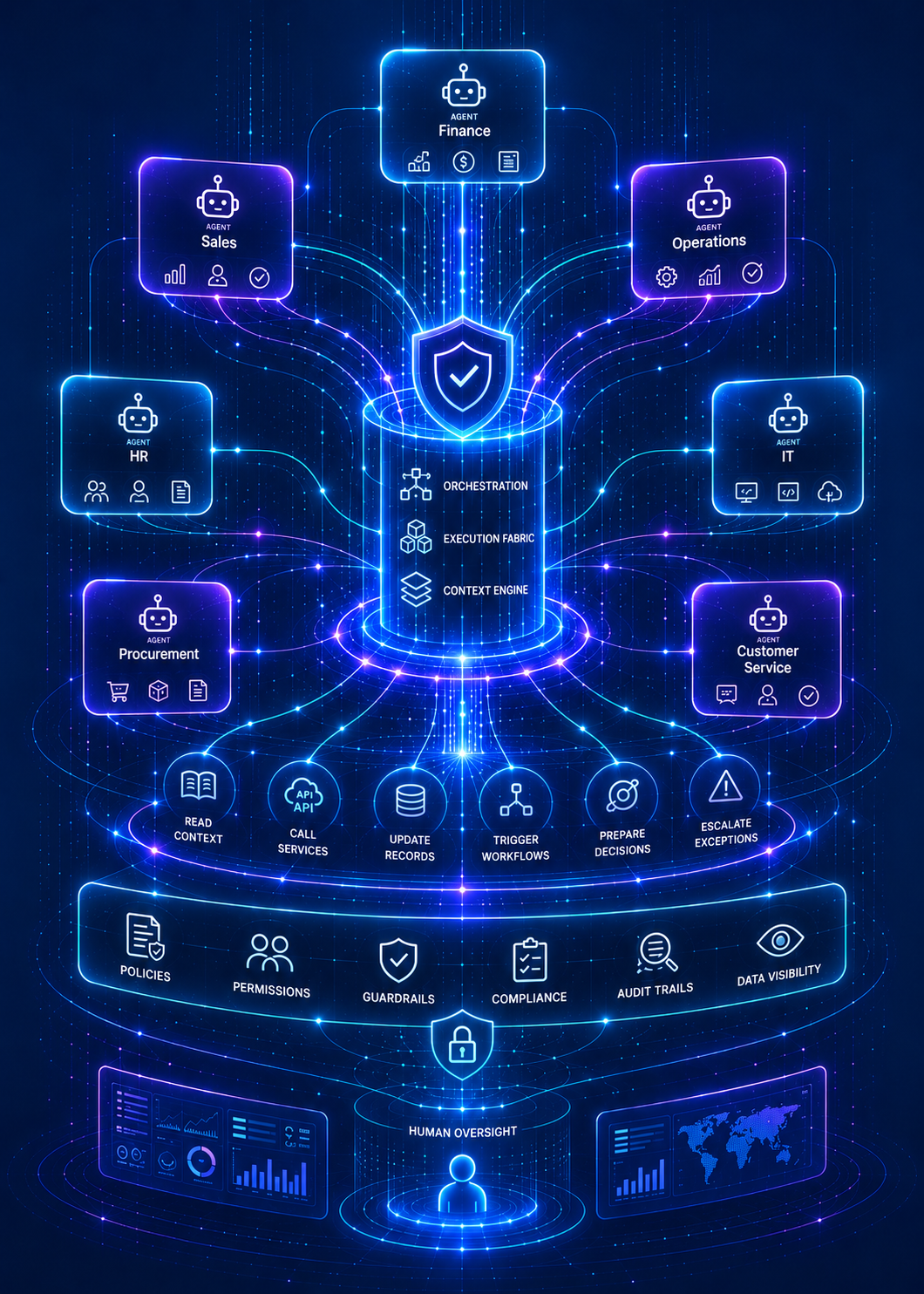
Advanze treats AI agents as participants in the operating model. Agents can read context, call services, update records, trigger workflows, prepare decisions and escalate exceptions. Human teams remain responsible for judgement, governance and business accountability.

That distinction matters. The goal is not to add another chatbot to existing systems. The goal is to create an execution platform where work can move across functions with consistent permissions, policies, audit trails and data visibility.

Business outcomes

What becomes possible

Outcome alignmentTie workflows to measurable business objectives.
Execution velocityReduce handoffs, manual follow-up and status chasing.
Control and governanceEmbed approvals, policies and audit evidence into work.
Data-driven improvementUse unified telemetry to improve continuously.
Security and governance professionals reviewing operational risk and evidence.
The outcome is not just automation. It is confidence in what happens next. When Governance Risk Compliance runs inside a governed execution model, teams can move faster without losing judgement, accountability or trust.

Agentic use case

Where Governance Risk Compliance becomes governed execution.

An incident needs to be logged and resolved.

What makes it harder in the real world: Incidents may involve customer impact, cyber risk, legal notification, regulatory timelines, operational disruption, SLA exposure, root-cause analysis and executive communication.

What Advanze changes: Coordinate incident intake, severity classification, evidence collection, stakeholder notification, escalation and remediation tasks through governed agentic workflow.

Triage AgentClassifies incident type, severity, affected systems and urgency.
Evidence AgentCollects logs, records, screenshots, ticket history and related events.
Security AgentChecks whether the event involves cyber, data loss, access compromise or suspicious activity.
Compliance AgentChecks regulatory notification, policy requirements and audit obligations.
Communications AgentDrafts internal updates, customer notices and executive summaries for approval.
Challenge

Incidents may involve customer impact, cyber risk, legal notification, regulatory timelines, operational disruption, SLA exposure, root-cause analysis and executive communication.

Orchestration

Coordinate incident intake, severity classification, evidence collection, stakeholder notification, escalation and remediation tasks through governed agentic workflow.

Success

Coordinate incident intake, severity classification, evidence collection, stakeholder notification, escalation and remediation tasks through governed agentic workflow.

Security and governance professionals reviewing operational risk and evidence.
Security governance 13Security, compliance and operations teams coordinating response through evidence and approval boundaries.
Security and governance professionals reviewing operational risk and evidence.
Security governance 14Security, compliance and operations teams coordinating response through evidence and approval boundaries.
Security and governance professionals reviewing operational risk and evidence.
Security governance 15Security, compliance and operations teams coordinating response through evidence and approval boundaries.

Why AI execution needs architecture

The work needs context, controls and clear permissions before automation can safely act.

That is why the Advanze control model matters: identity, permissions, policies, workflow, audit evidence and human judgement are embedded into execution before agents act.

  • Incidents may involve customer impact, cyber risk, legal notification, regulatory timelines, operational disruption, SLA exposure, root-cause analysis and executive communication.
  • The right agent must receive the right context, tools, permissions and approval path before work moves forward.
  • Audit evidence, exception handling and human judgement need to be part of the workflow, not notes added after the fact.

Implementation path

How to move from concept to production

Advanze can be introduced progressively. The recommended path is to start with a visible workflow, prove the operating model, then expand into adjacent capabilities as the platform foundation matures.

  1. 1
    Assess the current operating model

    Map the workflows, systems, data sources and manual coordination points around this capability.

  2. 2
    Design the target execution flow

    Define the data model, human approvals, agent tasks, service calls and governance controls.

  3. 3
    Launch a focused implementation wave

    Start with a bounded use case that proves the operating pattern and creates reusable platform assets.

  4. 4
    Scale across the business

    Extend the pattern to adjacent workflows, more agents, more users and deeper integrations.

Next step

Build this into your execution platform roadmap

Explore how Governance Risk Compliance can be implemented as part of a broader Advanze platform adoption programme, from first pilot to enterprise scale.