
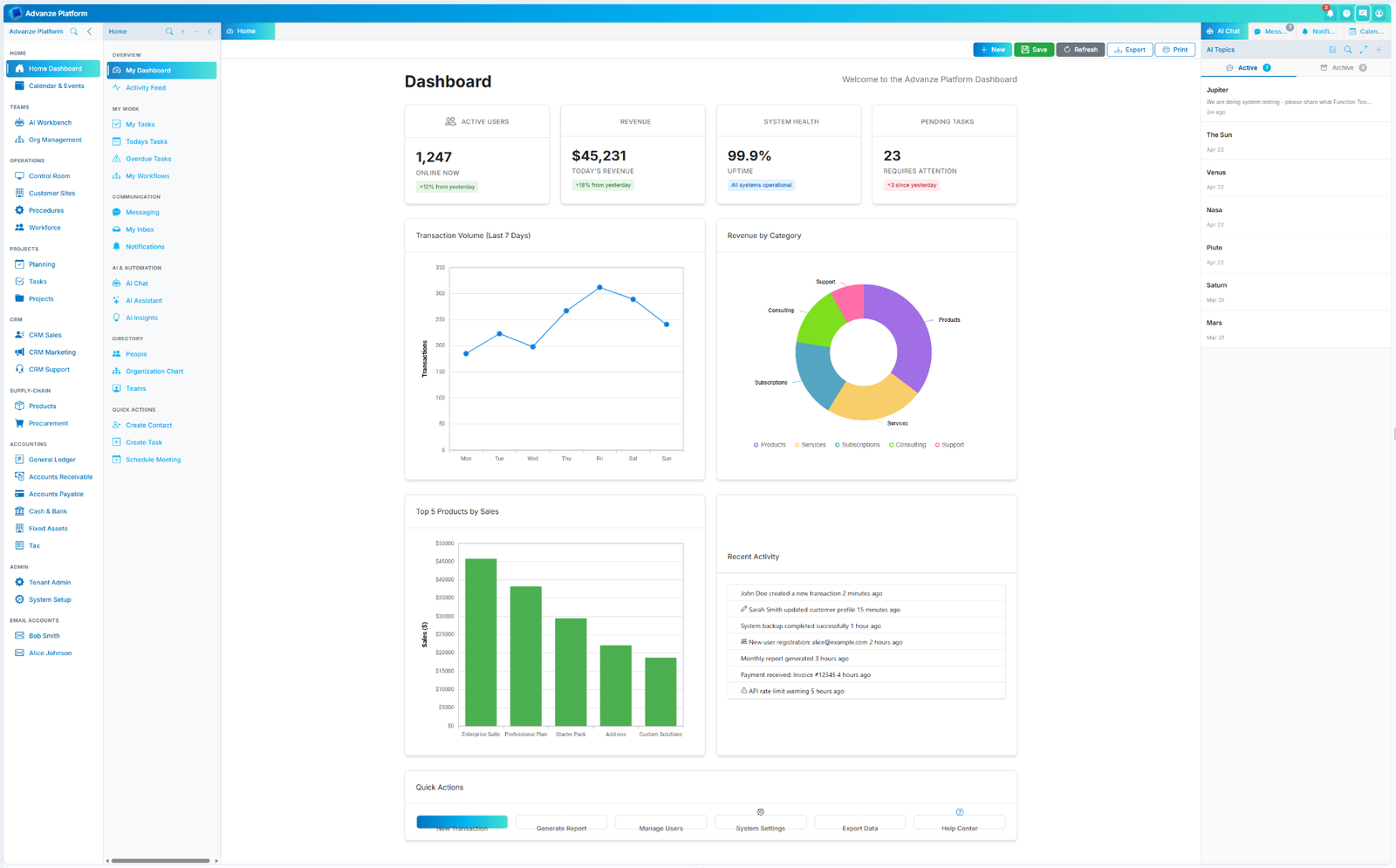
Unified Data Models
Define business entities once and use them everywhere. Data models connect operational records to analytics without extract-transform-load pipelines, keeping analysis current with live business activity.
Elevate & Transform
From manual coordination to measurable execution outcomes.
Data Analytics focuses on a business outcome rather than a software module. Advanze helps organisations move beyond manual coordination by giving teams, systems and AI agents one shared execution platform.

Business Objective / Data Analytics
Advanze is positioned around the idea that enterprise software must evolve from passive systems of record into active systems of execution. In that model, this page is not just a feature description. It explains how Data Analytics contributes to an operating environment where people define intent, agents execute governed work, and leadership can see progress through unified data.
The value is strongest when the capability is connected to adjacent processes. Records, workflows, controls, communications and analytics should not live in separate tools. They should participate in a shared execution fabric that can coordinate work across departments while preserving human accountability.

Core capabilities
Each capability is designed to work as part of the broader execution platform rather than as a disconnected module.
Define business entities once and use them everywhere. Data models connect operational records to analytics without extract-transform-load pipelines, keeping analysis current with live business activity.
Give leaders real-time visibility into business performance through dashboards that pull from unified operational data. Metrics update automatically as work happens, eliminating manual report preparation.
Define business metrics once with clear calculation logic and governance rules. The same metric definition powers dashboards, reports, alerts and agent decisions, ensuring consistency across the organisation.
Configure threshold-based or pattern-detection alerts that trigger workflows, escalations or agent interventions. Alerts can route notifications, assign tasks or initiate corrective actions automatically.
Enable business users to explore data through governed self-service tools. Pre-built data models and semantic metrics guide analysis while maintaining security boundaries and data quality standards.
AI agents can analyse trends, detect anomalies and prepare decision-support summaries. Agents work from the same unified data as human analysts, providing context-aware recommendations tied to workflows.
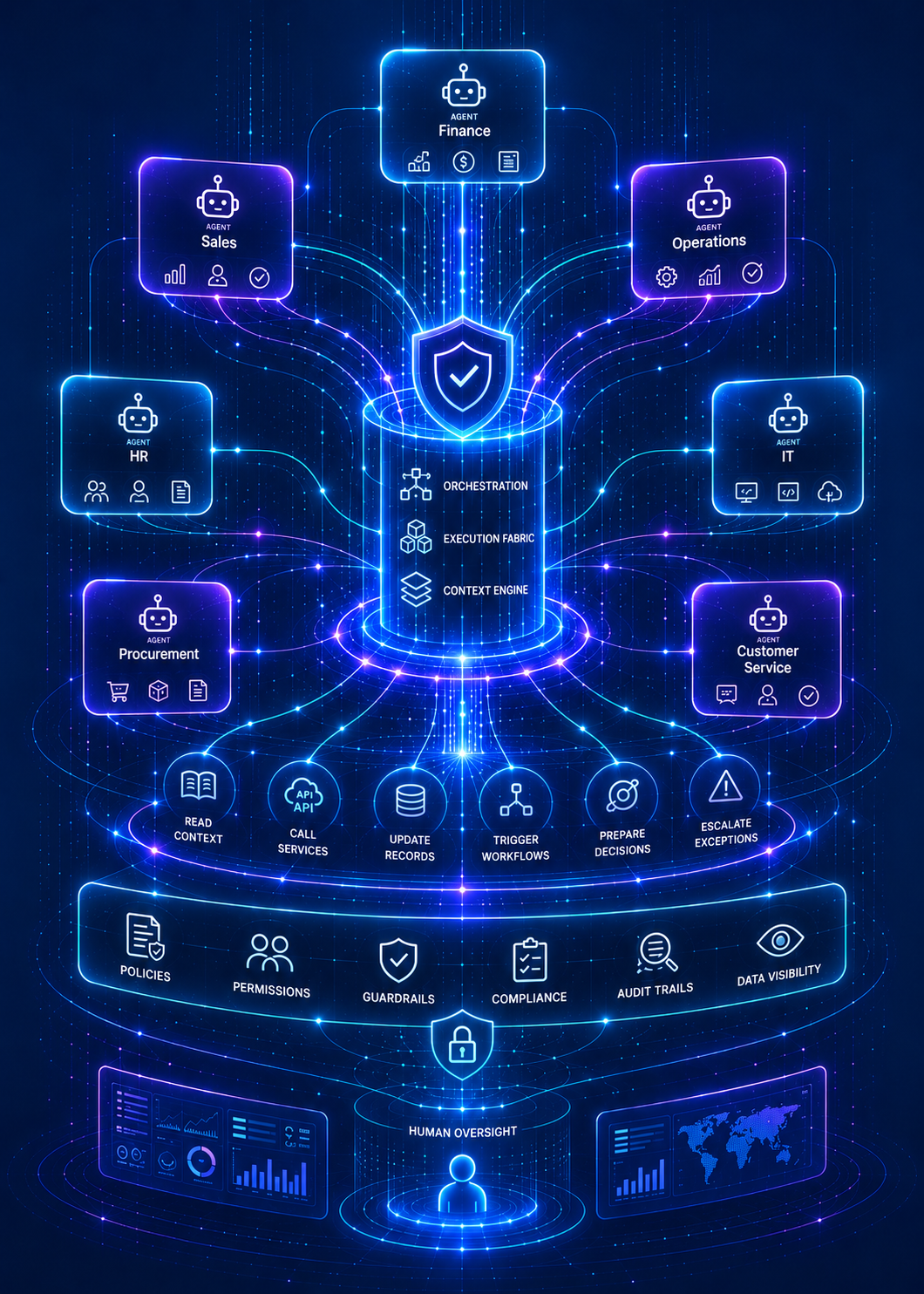
Agentic operating model
Advanze treats AI agents as participants in the operating model. Agents can read context, call services, update records, trigger workflows, prepare decisions and escalate exceptions. Human teams remain responsible for judgement, governance and business accountability.
That distinction matters. The goal is not to add another chatbot to existing systems. The goal is to create an execution platform where work can move across functions with consistent permissions, policies, audit trails and data visibility.
Business outcomes

Agentic use case
A bad import or system change has corrupted business records.
What makes it harder in the real world: Data correction requires evidence, impact analysis, ownership, approval, rollback choice, downstream notification and audit trail. A fast fix without traceability can make the incident worse.
What Advanze changes: Detect bad data, classify impact, identify the source, route approval and restore or correct records with auditable point-in-time recovery.
Data correction requires evidence, impact analysis, ownership, approval, rollback choice, downstream notification and audit trail. A fast fix without traceability can make the incident worse.
Detect bad data, classify impact, identify the source, route approval and restore or correct records with auditable point-in-time recovery.
Detect bad data, classify impact, identify the source, route approval and restore or correct records with auditable point-in-time recovery.


Why AI execution needs architecture
That is why the Advanze control model matters: identity, permissions, policies, workflow, audit evidence and human judgement are embedded into execution before agents act.
Implementation path
Advanze can be introduced progressively. The recommended path is to start with a visible workflow, prove the operating model, then expand into adjacent capabilities as the platform foundation matures.
Map the workflows, systems, data sources and manual coordination points around this capability.
Define the data model, human approvals, agent tasks, service calls and governance controls.
Start with a bounded use case that proves the operating pattern and creates reusable platform assets.
Extend the pattern to adjacent workflows, more agents, more users and deeper integrations.
Next step
Explore how Data Analytics can be implemented as part of a broader Advanze platform adoption programme, from first pilot to enterprise scale.