
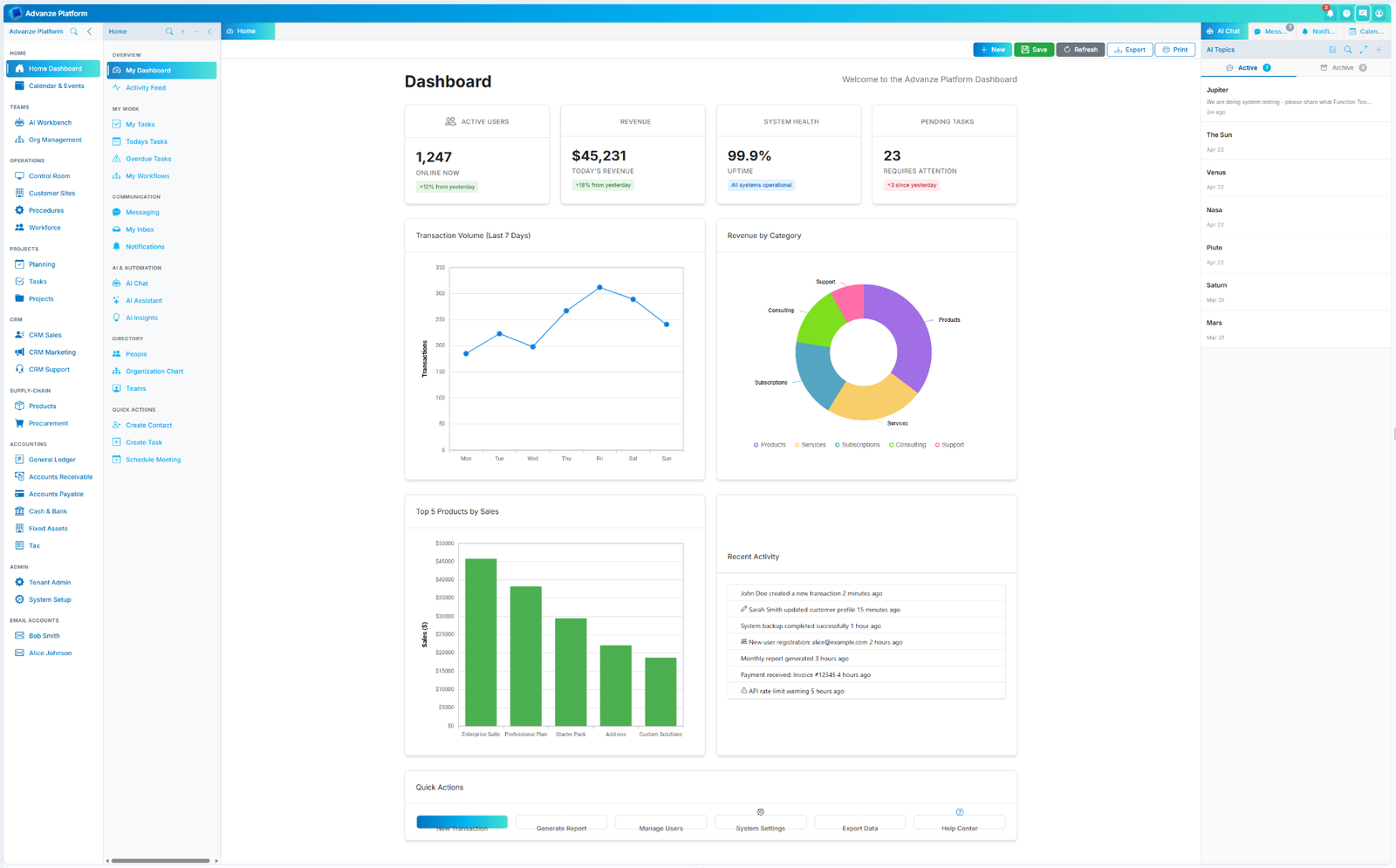
Global Company Lookup
Search corporate registries in 180+ jurisdictions to verify business existence, registration numbers, and legal status. Agents validate corporate customers during B2B onboarding workflows.
Execution Platform
Unified data, services, workflows and agents in one operating substrate.
Company Registry is part of the Advanze platform layer: the execution foundation that enables applications, services and AI agents to work as one operating system for the business. It is designed for extensibility, governance and scale from the start.

Execution Platform / Company Registry
Advanze is positioned around the idea that enterprise software must evolve from passive systems of record into active systems of execution. In that model, this page is not just a feature description. It explains how Company Registry contributes to an operating environment where people define intent, agents execute governed work, and leadership can see progress through unified data.
The value is strongest when the capability is connected to adjacent processes. Records, workflows, controls, communications and analytics should not live in separate tools. They should participate in a shared execution fabric that can coordinate work across departments while preserving human accountability.

Core capabilities
Each capability is designed to work as part of the broader execution platform rather than as a disconnected module.
Search corporate registries in 180+ jurisdictions to verify business existence, registration numbers, and legal status. Agents validate corporate customers during B2B onboarding workflows.
Retrieve shareholder information, beneficial owners, and corporate hierarchies where publicly available. Agents map ownership chains to identify ultimate beneficial owners for KYC compliance.
Access names, roles, and appointment dates of company directors and officers. Agents screen key individuals against sanctions lists and perform background checks automatically.
Retrieve articles of incorporation, certificates of good standing, and financial filings. Agents collect required documents to satisfy due diligence requirements without manual searching.
Monitor ongoing status changes like dissolutions, mergers, address changes, or officer appointments. Agents alert when material changes affect existing corporate customers.
Verify that company registration numbers match official records and haven't been fabricated. Agents cross-reference multiple data sources to detect fraudulent corporate identities.
Agentic operating model
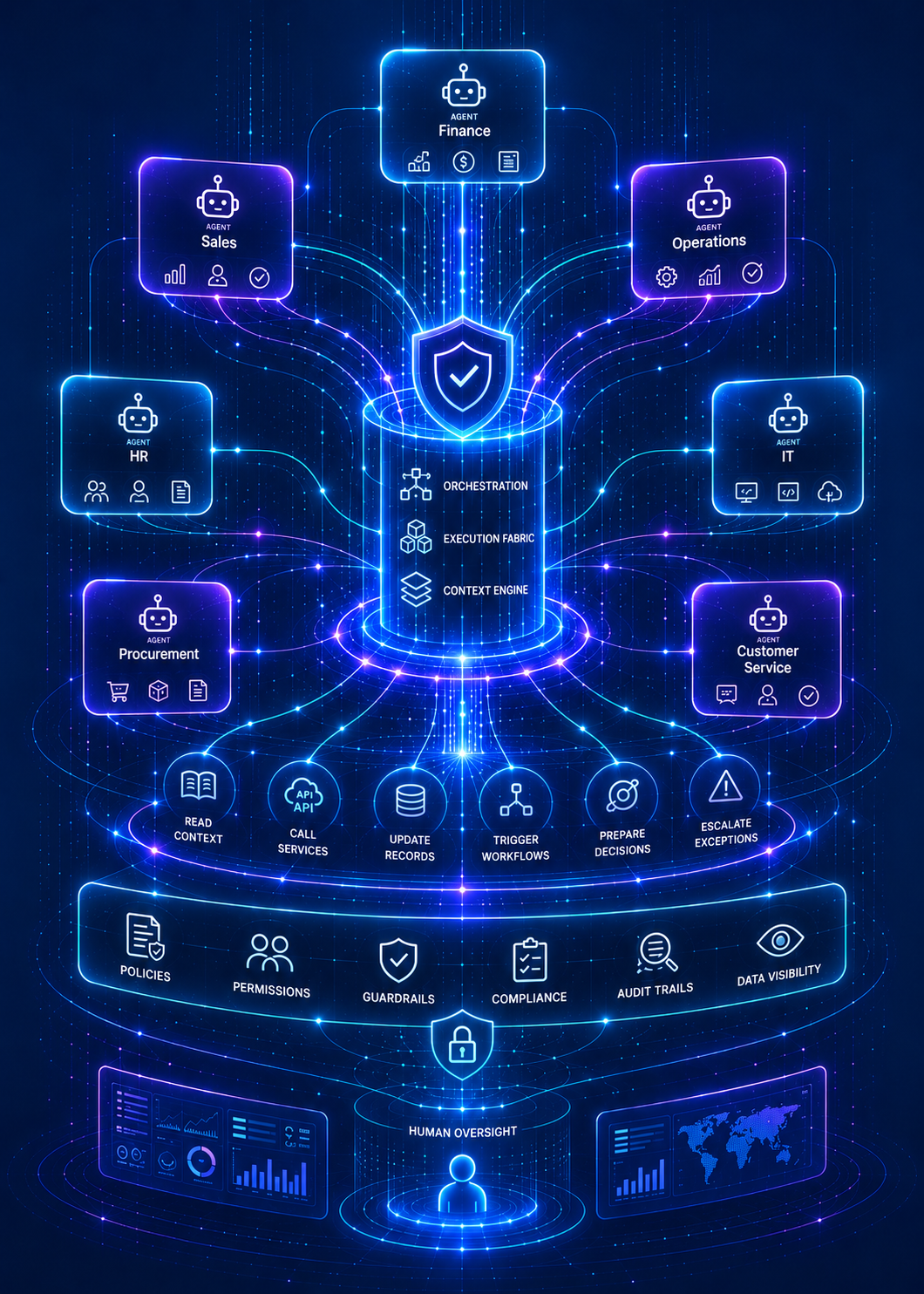
Advanze treats AI agents as active participants in the execution model rather than passive assistants. Agents can autonomously read context from unified data stores, call platform services to perform operations, update business records in real-time, trigger multi-step workflows, prepare decision packages for human approval, and escalate exceptions when policies require oversight. Human teams define the guardrails and maintain accountability for business outcomes.
This architecture matters because it transforms work execution across the enterprise. Instead of adding chatbots on top of disconnected systems, Advanze provides an execution substrate where agents operate with consistent permissions, follow the same governance policies as human users, generate complete audit trails for every action, and share unified data visibility with human colleagues. Work moves faster while control strengthens.
Business outcomes

Agentic use case
A new customer needs to be onboarded quickly.
What makes it harder in the real world: Onboarding often crosses identity verification, document collection, AML, sanctions, company registry checks, credit, legal terms, customer data quality, workflow approvals and audit evidence.
What Advanze changes: Coordinate onboarding, KYC checks, document review, risk scoring, approvals and customer communication through a governed agentic workflow.
Onboarding often crosses identity verification, document collection, AML, sanctions, company registry checks, credit, legal terms, customer data quality, workflow approvals and audit evidence.
Coordinate onboarding, KYC checks, document review, risk scoring, approvals and customer communication through a governed agentic workflow.
Coordinate onboarding, KYC checks, document review, risk scoring, approvals and customer communication through a governed agentic workflow.


Why AI execution needs architecture
That is why the Advanze control model matters: identity, permissions, policies, workflow, audit evidence and human judgement are embedded into execution before agents act.
Implementation path
Advanze can be introduced progressively. The recommended path is to start with a visible workflow, prove the operating model, then expand into adjacent capabilities as the platform foundation matures.
Map the workflows, systems, data sources and manual coordination points around this capability.
Define the data model, human approvals, agent tasks, service calls and governance controls.
Start with a bounded use case that proves the operating pattern and creates reusable platform assets.
Extend the pattern to adjacent workflows, more agents, more users and deeper integrations.
Next step
Explore how Company Registry can be implemented as part of a broader Advanze platform adoption programme, from first pilot to enterprise scale.