
API-First Integration
RESTful APIs with comprehensive documentation and SDKs in multiple languages. External systems call Advanze services or receive webhooks for event-driven integration patterns.
Execution Platform
Unified data, services, workflows and agents in one operating substrate.
Integration is part of the Advanze platform layer: the execution foundation that enables applications, services and AI agents to work as one operating system for the business. It is designed for extensibility, governance and scale from the start.

Execution Platform / Integration
Advanze is positioned around the idea that enterprise software must evolve from passive systems of record into active systems of execution. In that model, this page is not just a feature description. It explains how Integration contributes to an operating environment where people define intent, agents execute governed work, and leadership can see progress through unified data.
The value is strongest when the capability is connected to adjacent processes. Records, workflows, controls, communications and analytics should not live in separate tools. They should participate in a shared execution fabric that can coordinate work across departments while preserving human accountability.

Core capabilities
Each capability is designed to work as part of the broader execution platform rather than as a disconnected module.
RESTful APIs with comprehensive documentation and SDKs in multiple languages. External systems call Advanze services or receive webhooks for event-driven integration patterns.
Publish and subscribe to business events across the platform. Agents react to events from applications, workflows, or external systems to trigger automated responses.
Receive data via file uploads, API calls, or message queues with automatic validation and routing. Agents process incoming data through configurable transformation and enrichment pipelines.
Push data to external systems on demand or schedule. Support batch exports, real-time feeds, and API callbacks to keep downstream consumers synchronized.
Encrypted storage for API keys, OAuth tokens, and certificates with automatic rotation. Agents access external systems securely without exposing credentials in code or logs.
Track integration health, throughput, error rates, and latency in real-time. AI agents detect patterns that indicate degrading performance or imminent failures for proactive remediation.
Agentic operating model
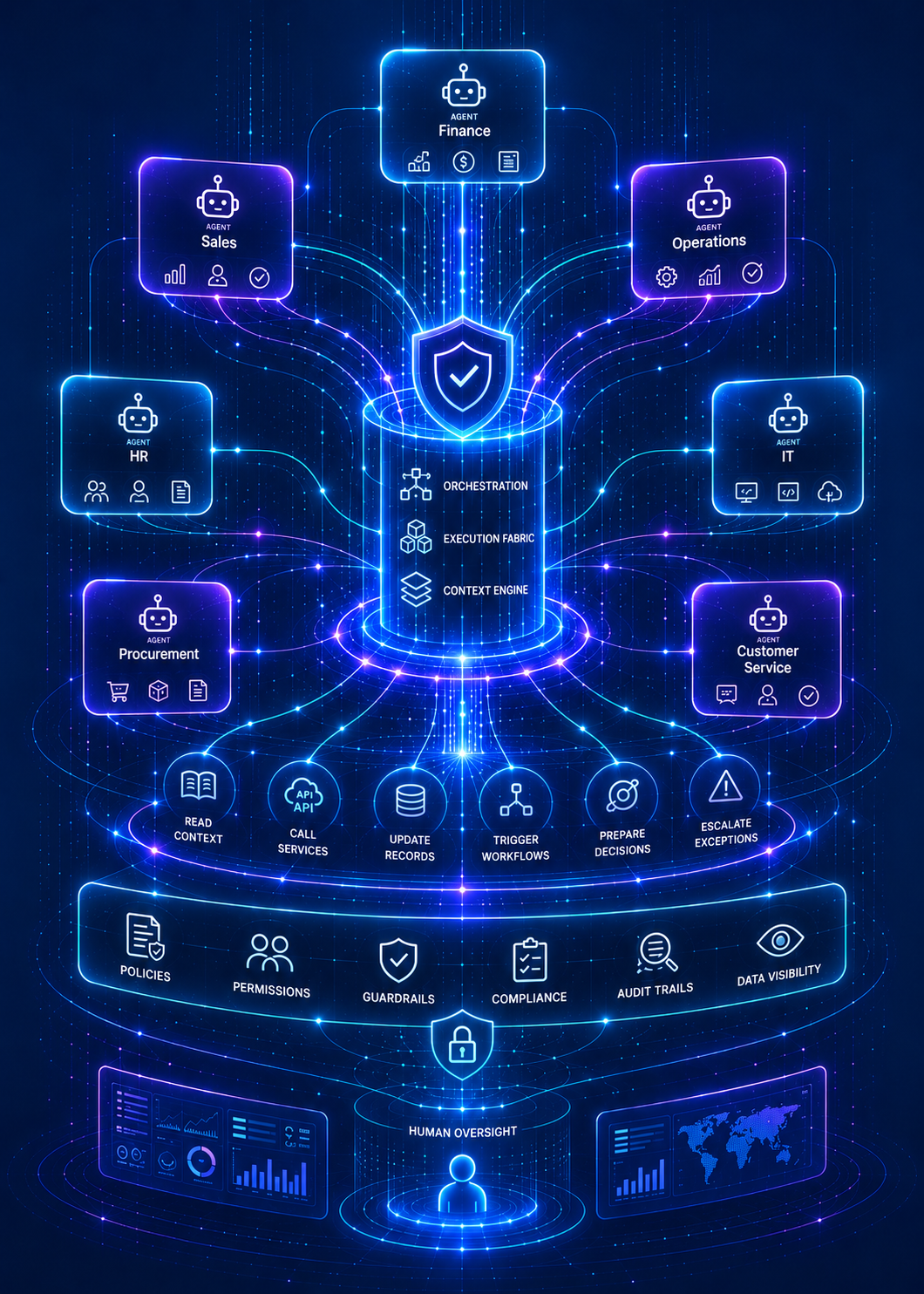
Advanze treats AI agents as active participants in the execution model rather than passive assistants. Agents can autonomously read context from unified data stores, call platform services to perform operations, update business records in real-time, trigger multi-step workflows, prepare decision packages for human approval, and escalate exceptions when policies require oversight. Human teams define the guardrails and maintain accountability for business outcomes.
This architecture matters because it transforms work execution across the enterprise. Instead of adding chatbots on top of disconnected systems, Advanze provides an execution substrate where agents operate with consistent permissions, follow the same governance policies as human users, generate complete audit trails for every action, and share unified data visibility with human colleagues. Work moves faster while control strengthens.
Business outcomes

Agentic use case
Teams want to use AI more widely.
What makes it harder in the real world: The cost of enterprise AI is not only token price. It includes context packaging, orchestration, approvals, safety layers, retries, evaluations, auditability and operations support.
What Advanze changes: Control AI execution by routing tasks to the right model, setting run budgets, applying permissions, stopping loops and reporting usage by use case.
The cost of enterprise AI is not only token price. It includes context packaging, orchestration, approvals, safety layers, retries, evaluations, auditability and operations support.
Control AI execution by routing tasks to the right model, setting run budgets, applying permissions, stopping loops and reporting usage by use case.
Control AI execution by routing tasks to the right model, setting run budgets, applying permissions, stopping loops and reporting usage by use case.



Why AI execution needs architecture
That is why the Advanze control model matters: identity, permissions, policies, workflow, audit evidence and human judgement are embedded into execution before agents act.
Implementation path
Advanze can be introduced progressively. The recommended path is to start with a visible workflow, prove the operating model, then expand into adjacent capabilities as the platform foundation matures.
Map the workflows, systems, data sources and manual coordination points around this capability.
Define the data model, human approvals, agent tasks, service calls and governance controls.
Start with a bounded use case that proves the operating pattern and creates reusable platform assets.
Extend the pattern to adjacent workflows, more agents, more users and deeper integrations.
Next step
Explore how Integration can be implemented as part of a broader Advanze platform adoption programme, from first pilot to enterprise scale.