
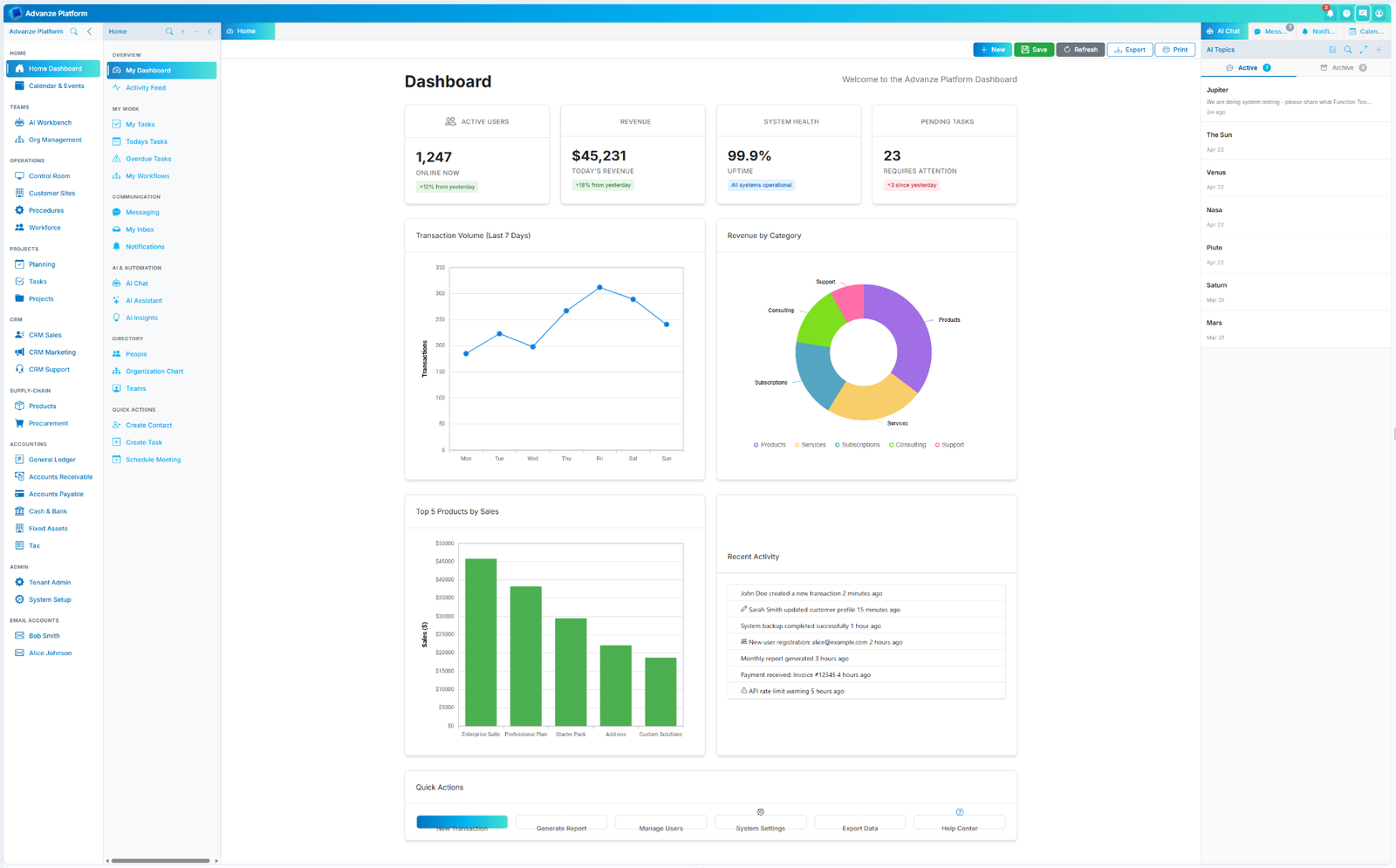
Publish-Subscribe Model
Producers emit events without knowing who will consume them. Subscribers register interest in event types and receive matching messages. Loose coupling allows services and agents to evolve independently.
Execution Platform
Unified data, services, workflows and agents in one operating substrate.
Eventing is part of the Advanze platform layer: the execution foundation that enables applications, services and AI agents to work as one operating system for the business. It is designed for extensibility, governance and scale from the start.

Execution Platform / Eventing
Advanze is positioned around the idea that enterprise software must evolve from passive systems of record into active systems of execution. In that model, this page is not just a feature description. It explains how Eventing contributes to an operating environment where people define intent, agents execute governed work, and leadership can see progress through unified data.
The value is strongest when the capability is connected to adjacent processes. Records, workflows, controls, communications and analytics should not live in separate tools. They should participate in a shared execution fabric that can coordinate work across departments while preserving human accountability.

Core capabilities
Each capability is designed to work as part of the broader execution platform rather than as a disconnected module.
Producers emit events without knowing who will consume them. Subscribers register interest in event types and receive matching messages. Loose coupling allows services and agents to evolve independently.
Workflows trigger automatically when business events occur. Event subscriptions replace manual polling. Agents react to real-time conditions instead of waiting for scheduled batch jobs.
Complete history of state changes is preserved in the event log. Audit trails and compliance reporting query the event stream. State can be reconstructed by replaying events from any point in time.
Subscribers filter events by type, source and custom attributes. Only relevant events are delivered to each consumer. Agents subscribe to narrow event streams to avoid processing irrelevant notifications.
Events are persisted before acknowledgment to prevent message loss. Retry logic handles transient failures. Dead-letter queues capture events that fail after all retries.
Events flow across service boundaries to coordinate distributed operations. Saga patterns manage long-running transactions through compensating events. Agents participate in sagas as autonomous decision-makers.
Agentic operating model
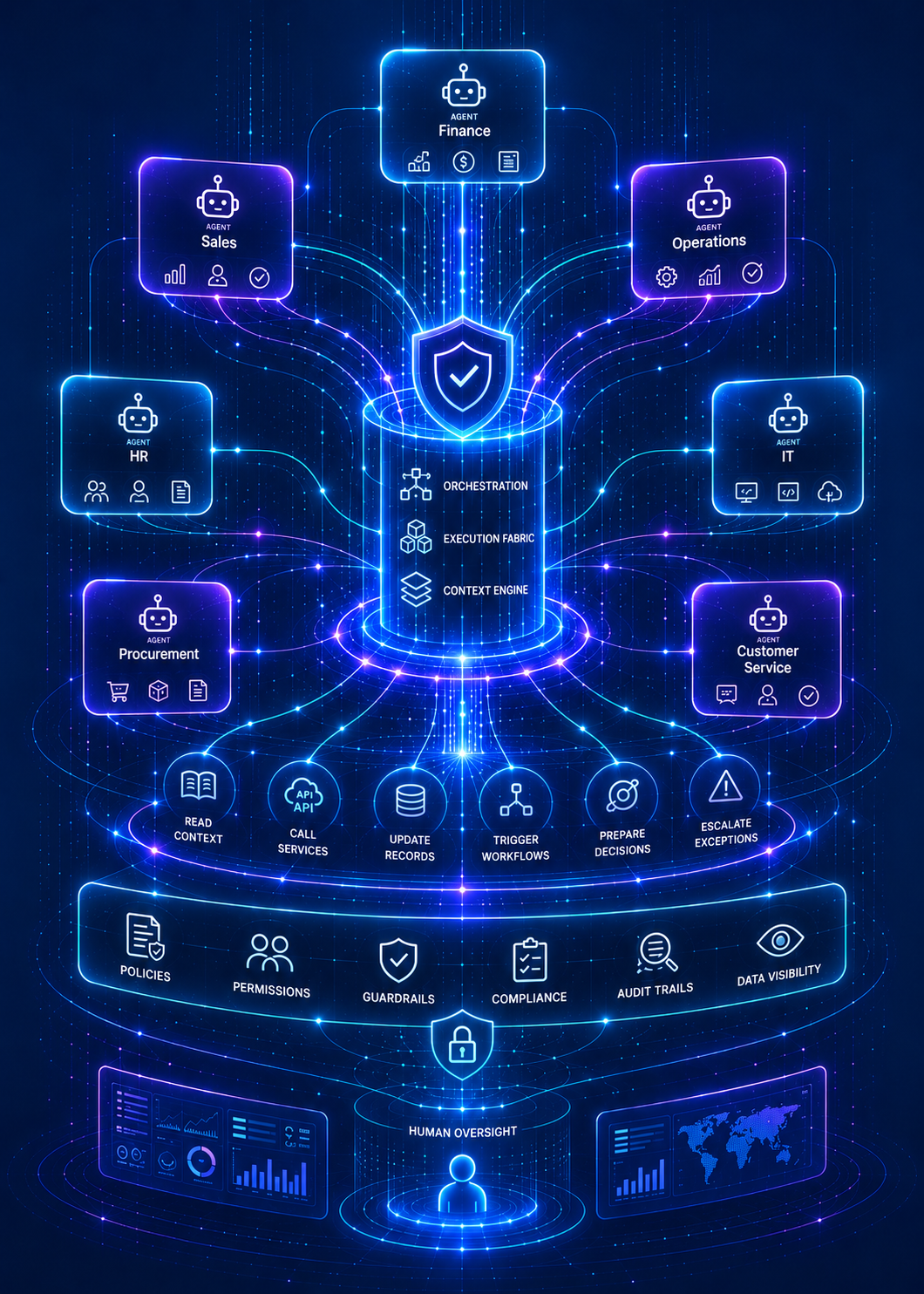
Advanze treats AI agents as participants in the operating model. Agents can read context, call services, update records, trigger workflows, prepare decisions and escalate exceptions. Human teams remain responsible for judgement, governance and business accountability.
That distinction matters. The goal is not to add another chatbot to existing systems. The goal is to create an execution platform where work can move across functions with consistent permissions, policies, audit trails and data visibility.
Business outcomes

Agentic use case
Teams want to use AI more widely.
What makes it harder in the real world: The cost of enterprise AI is not only token price. It includes context packaging, orchestration, approvals, safety layers, retries, evaluations, auditability and operations support.
What Advanze changes: Control AI execution by routing tasks to the right model, setting run budgets, applying permissions, stopping loops and reporting usage by use case.
The cost of enterprise AI is not only token price. It includes context packaging, orchestration, approvals, safety layers, retries, evaluations, auditability and operations support.
Control AI execution by routing tasks to the right model, setting run budgets, applying permissions, stopping loops and reporting usage by use case.
Control AI execution by routing tasks to the right model, setting run budgets, applying permissions, stopping loops and reporting usage by use case.



Why AI execution needs architecture
That is why the Advanze control model matters: identity, permissions, policies, workflow, audit evidence and human judgement are embedded into execution before agents act.
Implementation path
Advanze can be introduced progressively. The recommended path is to start with a visible workflow, prove the operating model, then expand into adjacent capabilities as the platform foundation matures.
Map the workflows, systems, data sources and manual coordination points around this capability.
Define the data model, human approvals, agent tasks, service calls and governance controls.
Start with a bounded use case that proves the operating pattern and creates reusable platform assets.
Extend the pattern to adjacent workflows, more agents, more users and deeper integrations.
Next step
Explore how Eventing can be implemented as part of a broader Advanze platform adoption programme, from first pilot to enterprise scale.