
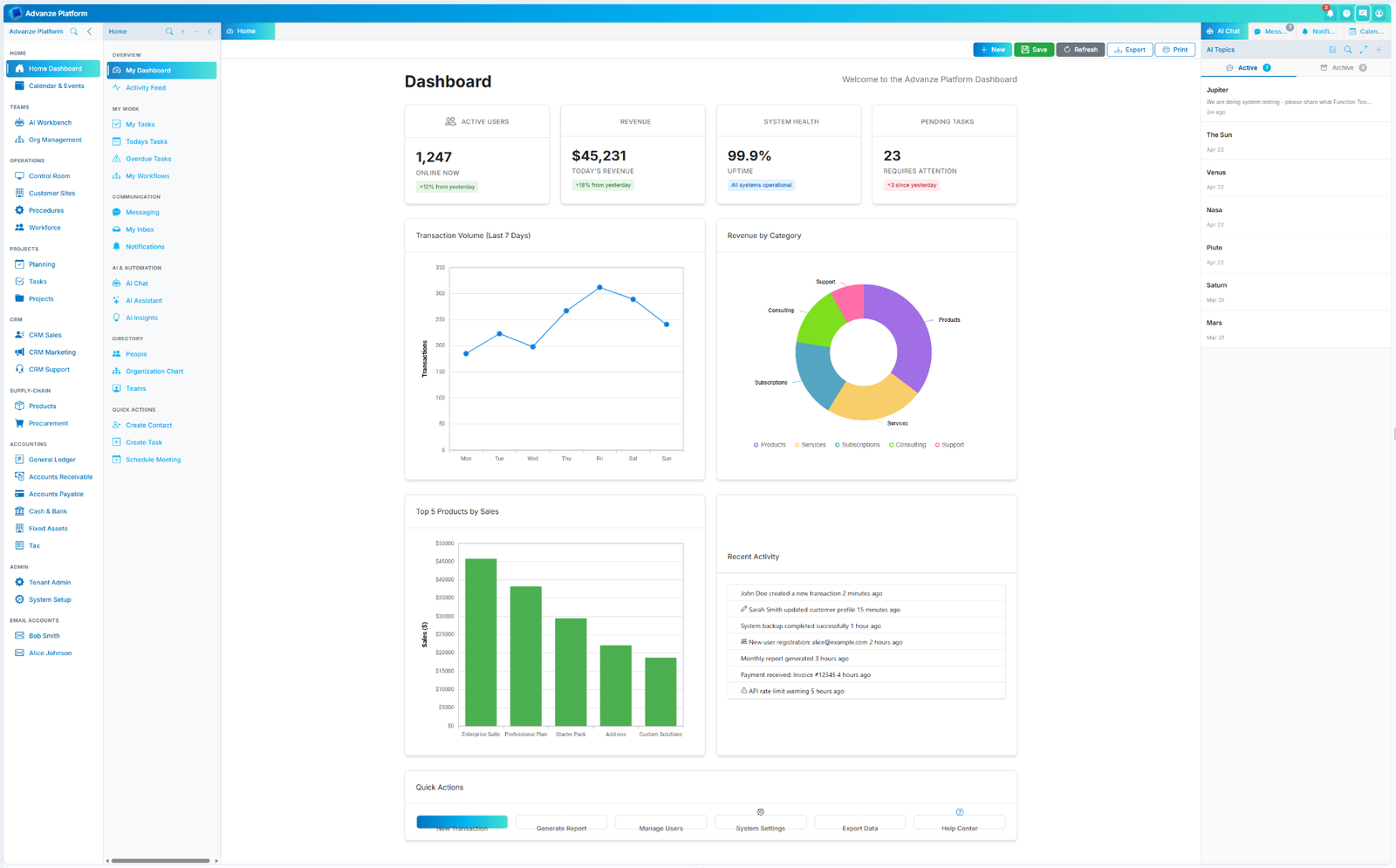
Unified Records
Employee master data with full lifecycle tracking from hire to exit. Maintain personal information, employment history, organizational relationships and document storage while enforcing data privacy and access controls.
Product Suite
Specialist capability. Shared platform. Agentic execution.
HR Core runs as part of the Advanze Execution Platform, so the application is not isolated software. It shares the same data foundation, workflow engine, security model and agentic AI fabric as the rest of the enterprise suite. Teams get the specialist capability they need without creating another silo.

Product Suite / HR Core
Advanze is positioned around the idea that enterprise software must evolve from passive systems of record into active systems of execution. In that model, this page is not just a feature description. It explains how HR Core contributes to an operating environment where people define intent, agents execute governed work, and leadership can see progress through unified data.
The value is strongest when the capability is connected to adjacent processes. Records, workflows, controls, communications and analytics should not live in separate tools. They should participate in a shared execution fabric that can coordinate work across departments while preserving human accountability.

Core capabilities
Each capability is designed to work as part of the broader execution platform rather than as a disconnected module.
Employee master data with full lifecycle tracking from hire to exit. Maintain personal information, employment history, organizational relationships and document storage while enforcing data privacy and access controls.
AI agents that can draft job descriptions, recommend salary bands based on market data and automatically generate offer letters from templates. Agents handle routine HR inquiries and escalate complex cases to human HR staff.
Automated HR policies for probation tracking, contract renewals and compliance notifications. Apply employment law rules, enforce company policies and trigger workflows when employee status changes require action.
Workforce planning analytics showing headcount trends, turnover rates and demographic distributions. Monitor diversity metrics, forecast hiring needs and analyze cost-per-hire across recruitment channels.
Hierarchical approval chains for position requisitions, transfers and terminations. Route requests through appropriate stakeholders, maintain approval audit trails and ensure proper authorization before HR actions execute.
Turnover analysis identifies retention risks, time-to-fill metrics reveal recruitment bottlenecks and compensation analysis ensures pay equity across similar roles and experience levels.
Agentic operating model
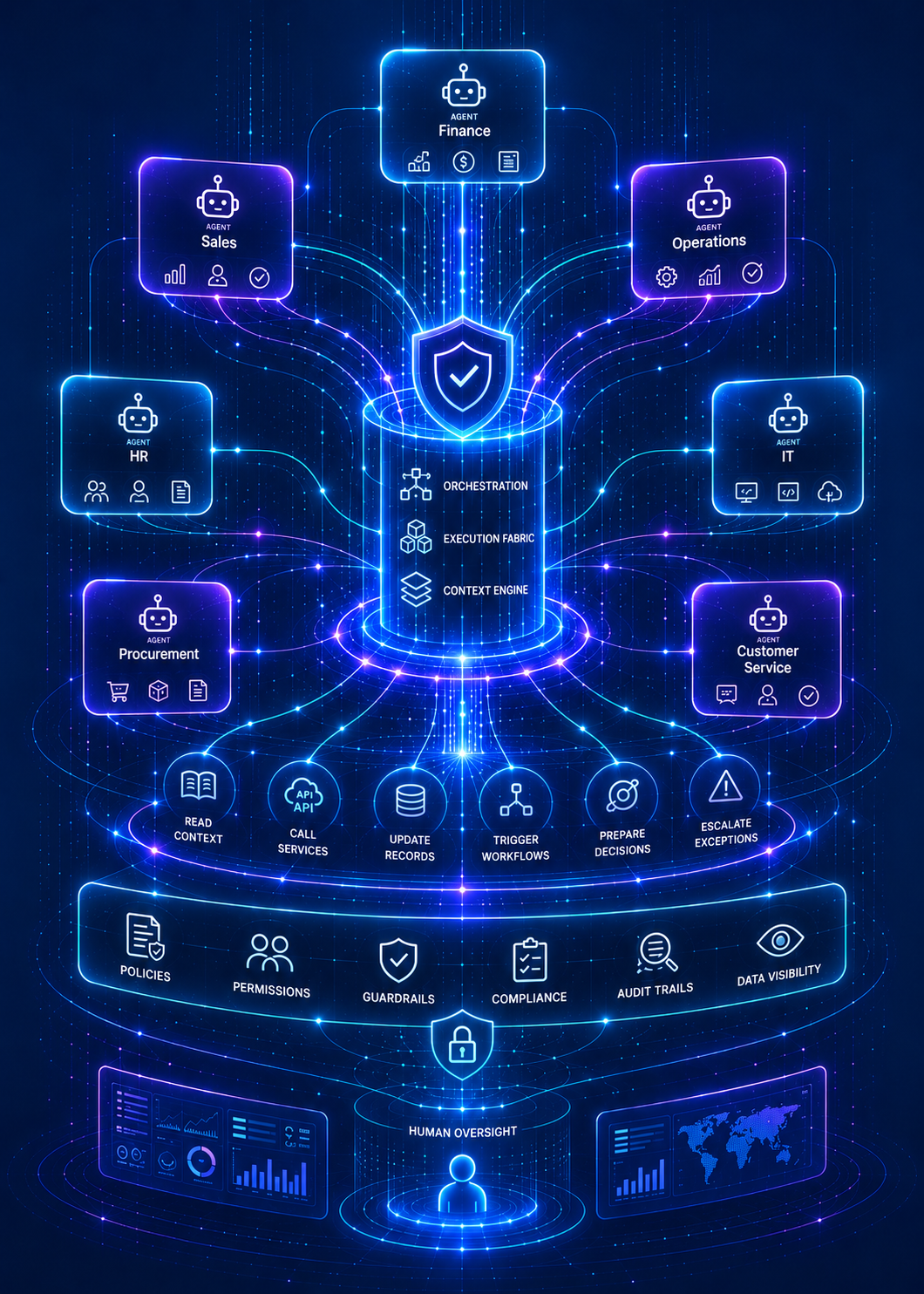
Advanze treats AI agents as participants in the operating model. Agents can read context, call services, update records, trigger workflows, prepare decisions and escalate exceptions. Human teams remain responsible for judgement, governance and business accountability.
That distinction matters. The goal is not to add another chatbot to existing systems. The goal is to create an execution platform where work can move across functions with consistent permissions, policies, audit trails and data visibility.
Business outcomes

Agentic use case
It starts with a person trying to get hr core work done without losing context. They need the next action to be clear, but they also need confidence that the platform has checked the risk, evidence, permissions and downstream impact.
What makes it harder in the real world: Hr core work looks straightforward until it crosses people, systems, policies, approvals and customer impact. In practice, the work may require the right customer or employee context, policy checks, data quality, approvals, exception routing, integration updates and a clear audit trail.
What Advanze changes: HR Core turns hr core activity into governed execution by connecting employee, manager, access, policy and lifecycle context to agents, workflow, permissions, approvals and audit evidence before work is completed.
HR Core starts as a single app experience, but the real work usually depends on context from other teams, policies, data and systems.
Advanze treats HR Core as part of a governed execution fabric. The app captures the work, agents gather context, workflow routes approvals and the control model determines what can safely happen next.
HR Core becomes more than a screen. It becomes a reliable path from intent to controlled action, with people still responsible for judgement and the platform carrying evidence.


Why AI execution needs architecture
HR Core is valuable when it participates in the Advanze control model: identity, permissions, workflow, policy checks, data context, audit evidence and human approval boundaries sit inside the execution path.
Implementation path
Advanze can be introduced progressively. The recommended path is to start with a visible workflow, prove the operating model, then expand into adjacent capabilities as the platform foundation matures.
Map the workflows, systems, data sources and manual coordination points around this capability.
Define the data model, human approvals, agent tasks, service calls and governance controls.
Start with a bounded use case that proves the operating pattern and creates reusable platform assets.
Extend the pattern to adjacent workflows, more agents, more users and deeper integrations.
Next step
Explore how HR Core can be implemented as part of a broader Advanze platform adoption programme, from first pilot to enterprise scale.