
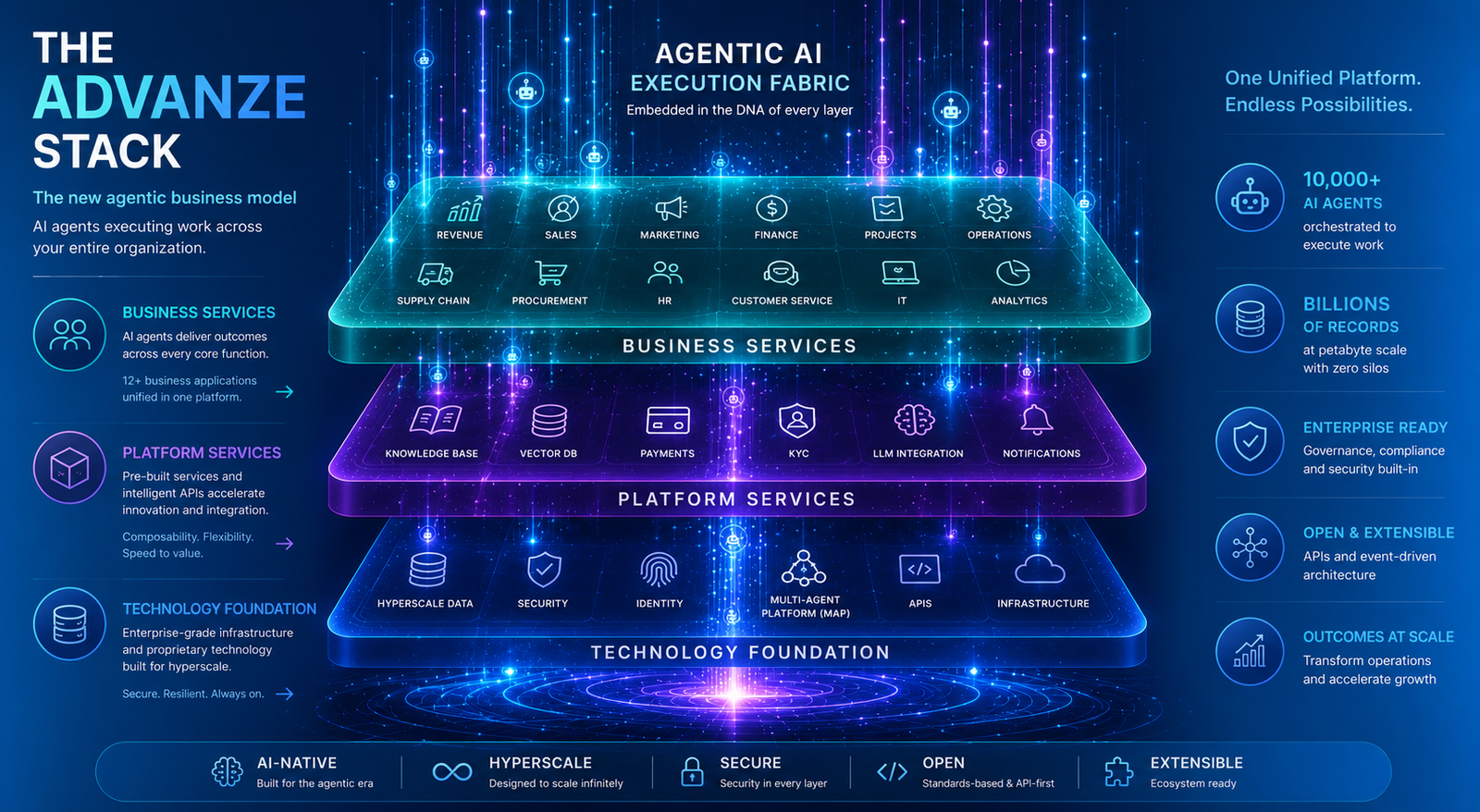
Tiered Plan Structure
Choose from Starter, Business, and Enterprise tiers aligned with organizational maturity. Each tier includes complete feature sets without artificial limitations or pay-per-module complexity.
Commercial Model
A simpler way to plan adoption, consolidation and scale.
Plans provides a commercial view of the Advanze platform. Pricing is designed to support consolidation, predictable adoption and a clearer relationship between platform investment and operating outcomes.

Commercial Model / Plans
Advanze is positioned around the idea that enterprise software must evolve from passive systems of record into active systems of execution. In that model, this page is not just a feature description. It explains how Plans contributes to an operating environment where people define intent, agents execute governed work, and leadership can see progress through unified data.
The value is strongest when the capability is connected to adjacent processes. Records, workflows, controls, communications and analytics should not live in separate tools. They should participate in a shared execution fabric that can coordinate work across departments while preserving human accountability.

Core capabilities
Each capability is designed to work as part of the broader execution platform rather than as a disconnected module.
Choose from Starter, Business, and Enterprise tiers aligned with organizational maturity. Each tier includes complete feature sets without artificial limitations or pay-per-module complexity.
Every plan includes platform core, data services, security, and integration hub. No feature gating—differences are capacity limits, service target commitments, and support levels, not functionality.
Mix subscription users with usage-based services. Combine per-user licensing for core apps with pay-as-you-go KYC checks, API calls, and messaging to match your business model.
Annual enterprise agreements unlock volume discounts, dedicated success management, and custom service targets. Predictable multi-year pricing protects against inflation and provides budget certainty.
Add business suites (HR, Finance, GRC) to any plan. Suite pricing stacks cleanly onto base platform subscriptions with transparent incremental costs and no hidden dependencies.
Upgrade seamlessly from Starter to Enterprise as you scale. No re-implementation, data migration, or feature re-training required—just increased capacity and enhanced support.
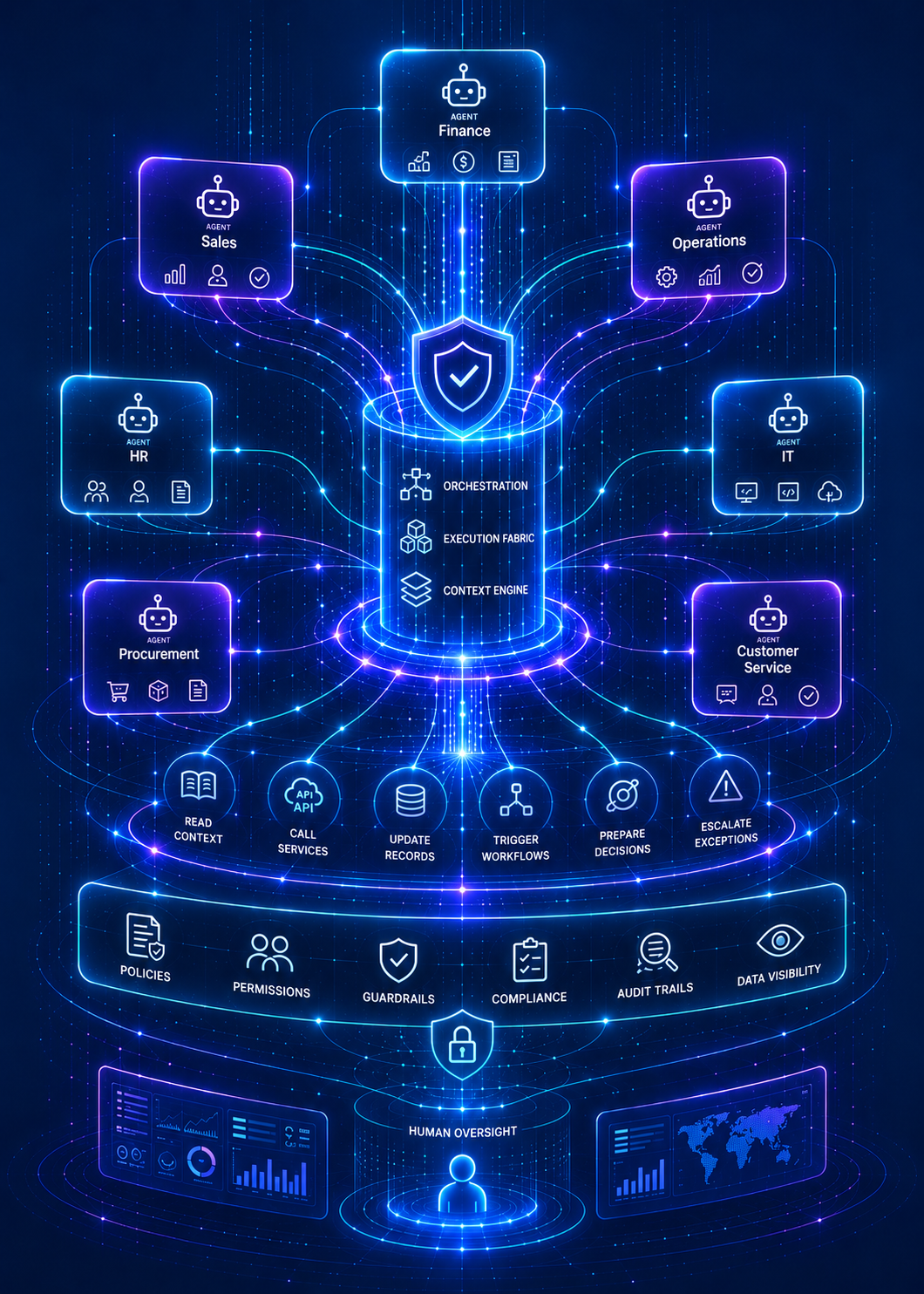
Agentic operating model
Advanze treats AI agents as participants in the operating model. Agents can read context, call services, update records, trigger workflows, prepare decisions and escalate exceptions. Human teams remain responsible for judgement, governance and business accountability.
That distinction matters. The goal is not to add another chatbot to existing systems. The goal is to create an execution platform where work can move across functions with consistent permissions, policies, audit trails and data visibility.
Business outcomes

Implementation path
Advanze can be introduced progressively. The recommended path is to start with a visible workflow, prove the operating model, then expand into adjacent capabilities as the platform foundation matures.
Identify which applications, services and integrations should be included in the first adoption wave.
Estimate consolidation savings, productivity lift and execution capacity using conservative assumptions.
Start with a focused pilot or move directly into a platform foundation programme.
Expand suites, agents and integrations with clear governance and measurement.
Why this pricing path matters
Teams want to use AI more widely.
What makes it harder in the real world: The cost of enterprise AI is not only token price. It includes context packaging, orchestration, approvals, safety layers, retries, evaluations, auditability and operations support.
What Advanze changes: Control AI execution by routing tasks to the right model, setting run budgets, applying permissions, stopping loops and reporting usage by use case.
The cost of enterprise AI is not only token price. It includes context packaging, orchestration, approvals, safety layers, retries, evaluations, auditability and operations support.
Control AI execution by routing tasks to the right model, setting run budgets, applying permissions, stopping loops and reporting usage by use case.
Control AI execution by routing tasks to the right model, setting run budgets, applying permissions, stopping loops and reporting usage by use case.



Control model
That is why pricing has to connect to the operating model: the number of users is only one part of the cost; the real value comes from governed execution, reusable controls and agent work that can safely scale.
Next step
Explore how Plans can be implemented as part of a broader Advanze platform adoption programme, from first pilot to enterprise scale.