Skip to content

Execution Platform

Data Resilience Recovery

Unified data, services, workflows and agents in one operating substrate.

Data Resilience Recovery is part of the Advanze platform layer: the execution foundation that enables applications, services and AI agents to work as one operating system for the business. It is designed for extensibility, governance and scale from the start.

Data and business teams reviewing analytics, resilience and recovery evidence.
Data Resilience Recovery starts with people trying to make the right call. A bad import or system change has corrupted business records.

Execution Platform / Data Resilience Recovery

Built as an execution foundation

Advanze is positioned around the idea that enterprise software must evolve from passive systems of record into active systems of execution. In that model, this page is not just a feature description. It explains how Data Resilience Recovery contributes to an operating environment where people define intent, agents execute governed work, and leadership can see progress through unified data.

The value is strongest when the capability is connected to adjacent processes. Records, workflows, controls, communications and analytics should not live in separate tools. They should participate in a shared execution fabric that can coordinate work across departments while preserving human accountability.

Data and business teams reviewing analytics, resilience and recovery evidence.
Where Data Resilience Recovery becomes real work people can trust. Data, analytics and resilience work connecting business decisions to governed evidence.

Core capabilities

What Data Resilience Recovery enables

Each capability is designed to work as part of the broader execution platform rather than as a disconnected module.

Point-in-Time Recovery

Restore data to defined points within the configured retention window without full database restore. Transaction-level recovery precision targets specific data changes for surgical rollback. PITR built into every table automatically without manual backup configuration.

Continuous Backup

Automatic snapshots capture full database state at configurable intervals. Incremental backups between snapshots minimize storage costs and recovery time. Backup data encrypts at rest and replicates to multiple regions.

Soft Delete Protection

Deleted records move to soft delete state instead of immediate removal. Recovery window allows restoration of accidentally deleted data before permanent purge. Automated cleanup jobs reclaim storage after retention period expires.

Snapshot Management

On-demand snapshots capture database state before risky operations like schema migrations. Named snapshots tag important milestones for easy identification. Snapshot retention policies balance compliance requirements with storage costs.

Disaster Recovery

Multi-region replication ensures data survives regional outages or catastrophic failures. Automated failover switches to backup region within minutes. Recovery time objective and recovery point objective meet enterprise service targets.

Recovery Testing

Automated recovery drills validate backup integrity without impacting production. Test restores to isolated environments verify data recoverability. Compliance reports demonstrate ability to meet regulatory recovery requirements.

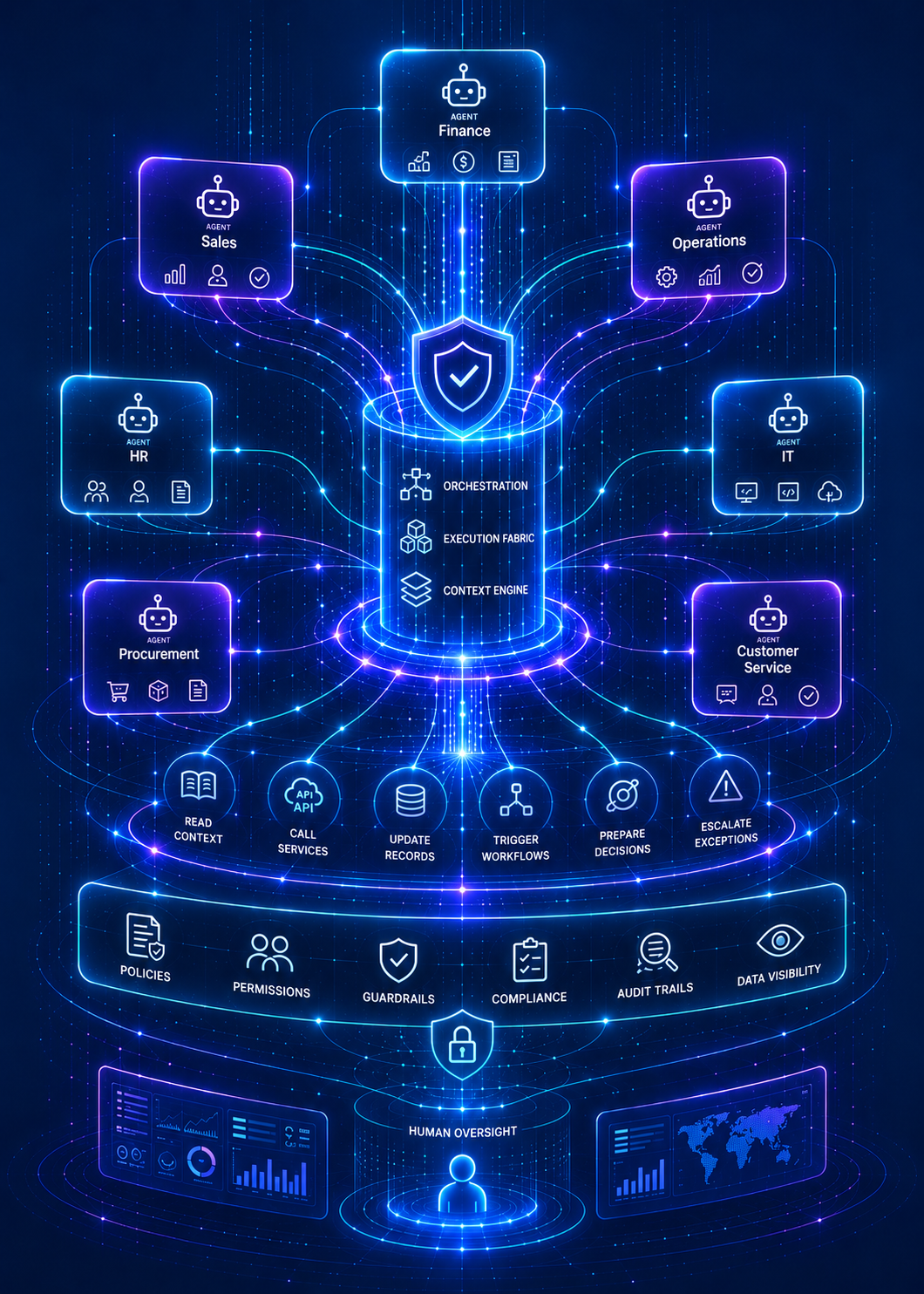
The Advanze Control Model - AI Agents Execute Work Inside the Control Model

Agentic operating model

AI agents execute work inside the control model

Advanze treats AI agents as participants in the operating model. Agents can read context, call services, update records, trigger workflows, prepare decisions and escalate exceptions. Human teams remain responsible for judgement, governance and business accountability.

That distinction matters. The goal is not to add another chatbot to existing systems. The goal is to create an execution platform where work can move across functions with consistent permissions, policies, audit trails and data visibility.

Business outcomes

What becomes possible

Scale by designArchitecture supports growing workloads, data and agent activity.
Governed automationSecurity, identity and controls are embedded in execution paths.
Composable servicesTeams can build faster using reusable platform capabilities.
Operational confidenceTelemetry and auditability make execution observable.
Data and business teams reviewing analytics, resilience and recovery evidence.
The outcome is not just automation. It is confidence in what happens next. When Data Resilience Recovery runs inside a governed execution model, teams can move faster without losing judgement, accountability or trust.

Agentic use case

Where Data Resilience Recovery becomes governed execution.

A bad import or system change has corrupted business records.

What makes it harder in the real world: Data correction requires evidence, impact analysis, ownership, approval, rollback choice, downstream notification and audit trail. A fast fix without traceability can make the incident worse.

What Advanze changes: Detect bad data, classify impact, identify the source, route approval and restore or correct records with auditable point-in-time recovery.

Data Quality AgentDetects anomaly, schema drift, duplicates or invalid values.
Impact AgentIdentifies affected tables, records, processes, customers and downstream systems.
Recovery AgentProposes record-level, table-level or full restore options based on snapshots and change logs.
Data OwnerApproves correction or restore decision.
Notification AgentDrafts stakeholder updates and creates downstream reconciliation tasks.
Challenge

Data correction requires evidence, impact analysis, ownership, approval, rollback choice, downstream notification and audit trail. A fast fix without traceability can make the incident worse.

Orchestration

Detect bad data, classify impact, identify the source, route approval and restore or correct records with auditable point-in-time recovery.

Success

Detect bad data, classify impact, identify the source, route approval and restore or correct records with auditable point-in-time recovery.

Data and business teams reviewing analytics, resilience and recovery evidence.
Data confidence 17Data, analytics and resilience work connecting business decisions to governed evidence.
Data and business teams reviewing analytics, resilience and recovery evidence.
Data confidence 18Data, analytics and resilience work connecting business decisions to governed evidence.
Data and business teams reviewing analytics, resilience and recovery evidence.
Data confidence 19Data, analytics and resilience work connecting business decisions to governed evidence.

Why AI execution needs architecture

The work needs context, controls and clear permissions before automation can safely act.

That is why the Advanze control model matters: identity, permissions, policies, workflow, audit evidence and human judgement are embedded into execution before agents act.

  • Data correction requires evidence, impact analysis, ownership, approval, rollback choice, downstream notification and audit trail. A fast fix without traceability can make the incident worse.
  • The right agent must receive the right context, tools, permissions and approval path before work moves forward.
  • Audit evidence, exception handling and human judgement need to be part of the workflow, not notes added after the fact.

Implementation path

How to move from concept to production

Advanze can be introduced progressively. The recommended path is to start with a visible workflow, prove the operating model, then expand into adjacent capabilities as the platform foundation matures.

  1. 1
    Assess the current operating model

    Map the workflows, systems, data sources and manual coordination points around this capability.

  2. 2
    Design the target execution flow

    Define the data model, human approvals, agent tasks, service calls and governance controls.

  3. 3
    Launch a focused implementation wave

    Start with a bounded use case that proves the operating pattern and creates reusable platform assets.

  4. 4
    Scale across the business

    Extend the pattern to adjacent workflows, more agents, more users and deeper integrations.

Next step

Build this into your execution platform roadmap

Explore how Data Resilience Recovery can be implemented as part of a broader Advanze platform adoption programme, from first pilot to enterprise scale.