Skip to content

Elevate & Transform

Revenue Growth

From manual coordination to measurable execution outcomes.

Revenue Growth focuses on a business outcome rather than a software module. Advanze helps organisations move beyond manual coordination by giving teams, systems and AI agents one shared execution platform.

Revenue team reviewing commercial work before customer commitment.
Revenue Growth starts with people trying to make the right call. A salesperson needs to send a proposal quickly.

Business Objective / Revenue Growth

Move from coordination effort to governed execution

Advanze is positioned around the idea that enterprise software must evolve from passive systems of record into active systems of execution. In that model, this page is not just a feature description. It explains how Revenue Growth contributes to an operating environment where people define intent, agents execute governed work, and leadership can see progress through unified data.

The value is strongest when the capability is connected to adjacent processes. Records, workflows, controls, communications and analytics should not live in separate tools. They should participate in a shared execution fabric that can coordinate work across departments while preserving human accountability.

Revenue team reviewing commercial work before customer commitment.
Where Revenue Growth becomes real work people can trust. Revenue teams aligning customer, proposal, commercial and delivery context before action.

Core capabilities

What Revenue Growth enables

Each capability is designed to work as part of the broader execution platform rather than as a disconnected module.

Market Expansion Orchestration

Coordinate new market entry across product launches, channel partnerships, regional operations and go-to-market execution. AI agents manage market analysis workflows, competitive positioning, localization requirements and cross-functional launch activities with unified tracking.

Customer Acquisition Optimization

Orchestrate demand generation, lead conversion and new customer onboarding workflows. Agents optimize channel performance, coordinate sales and marketing activities, trigger nurture campaigns and manage acquisition costs across customer segments and channels.

Revenue Retention & Expansion

Automated customer success workflows for retention, upsell and cross-sell opportunities. AI agents monitor usage patterns, health scores and engagement signals to trigger renewal campaigns, expansion plays and prevent churn across the customer base.

Pricing & Monetization Strategy

Dynamic pricing optimization and packaging workflows tied to market conditions, customer segments and competitive position. Agents analyze price elasticity, recommend adjustments, coordinate approval workflows and track revenue impact across pricing tiers and models.

Strategic Partnership Management

Orchestrate partner recruitment, enablement and channel performance optimization. AI agents manage partner agreements, coordinate co-marketing activities, track deal registration and revenue attribution while ensuring partner compliance and performance targets.

Growth Metrics & Intelligence

Unified growth analytics across customer acquisition cost, lifetime value, revenue per customer and expansion rates. Agents surface growth constraints, recommend resource allocation, trigger strategic initiatives and maintain executive dashboards with predictive growth modeling.

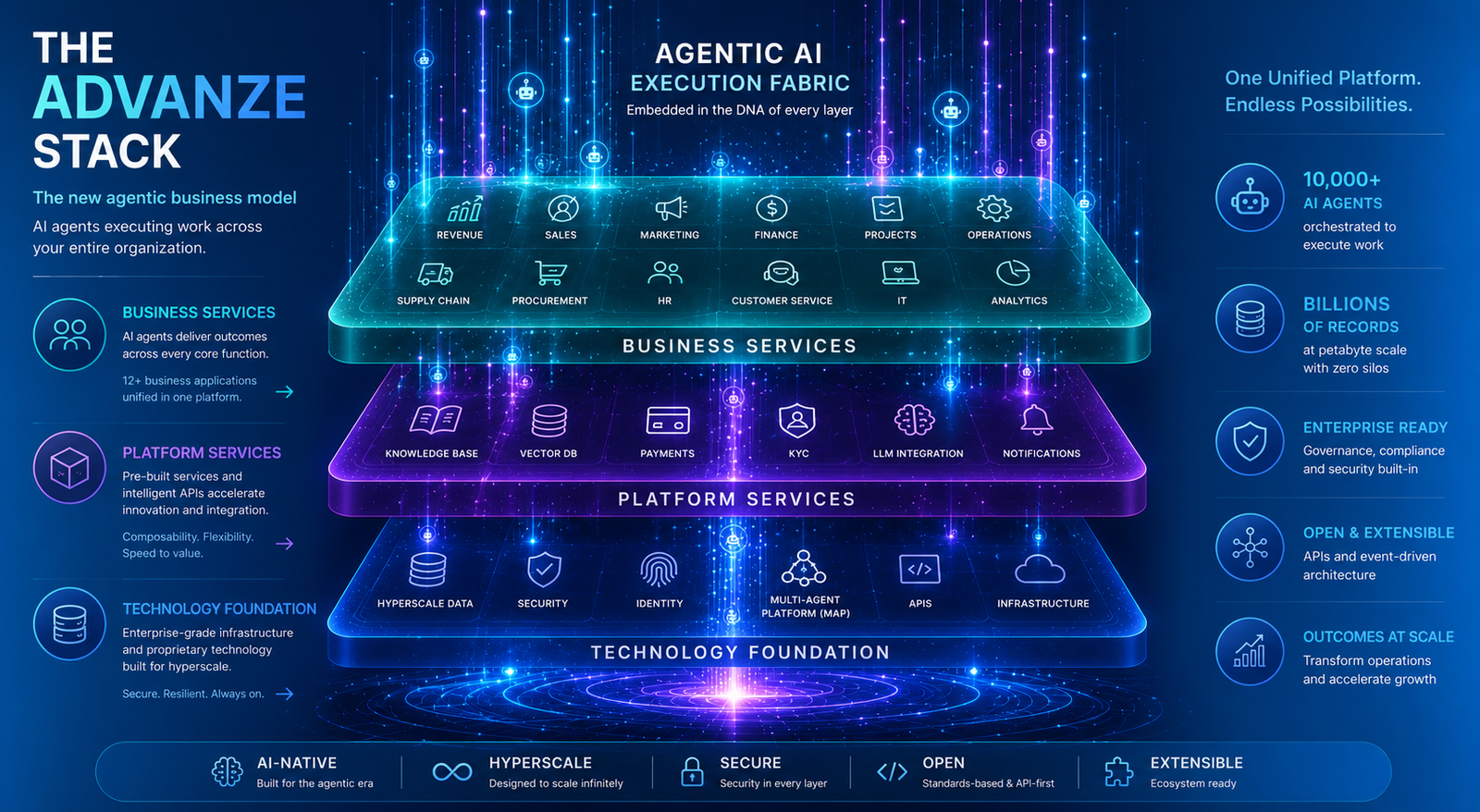
The Advanze Stack - Business Services, Platform Services, Technology Foundation

Agentic operating model

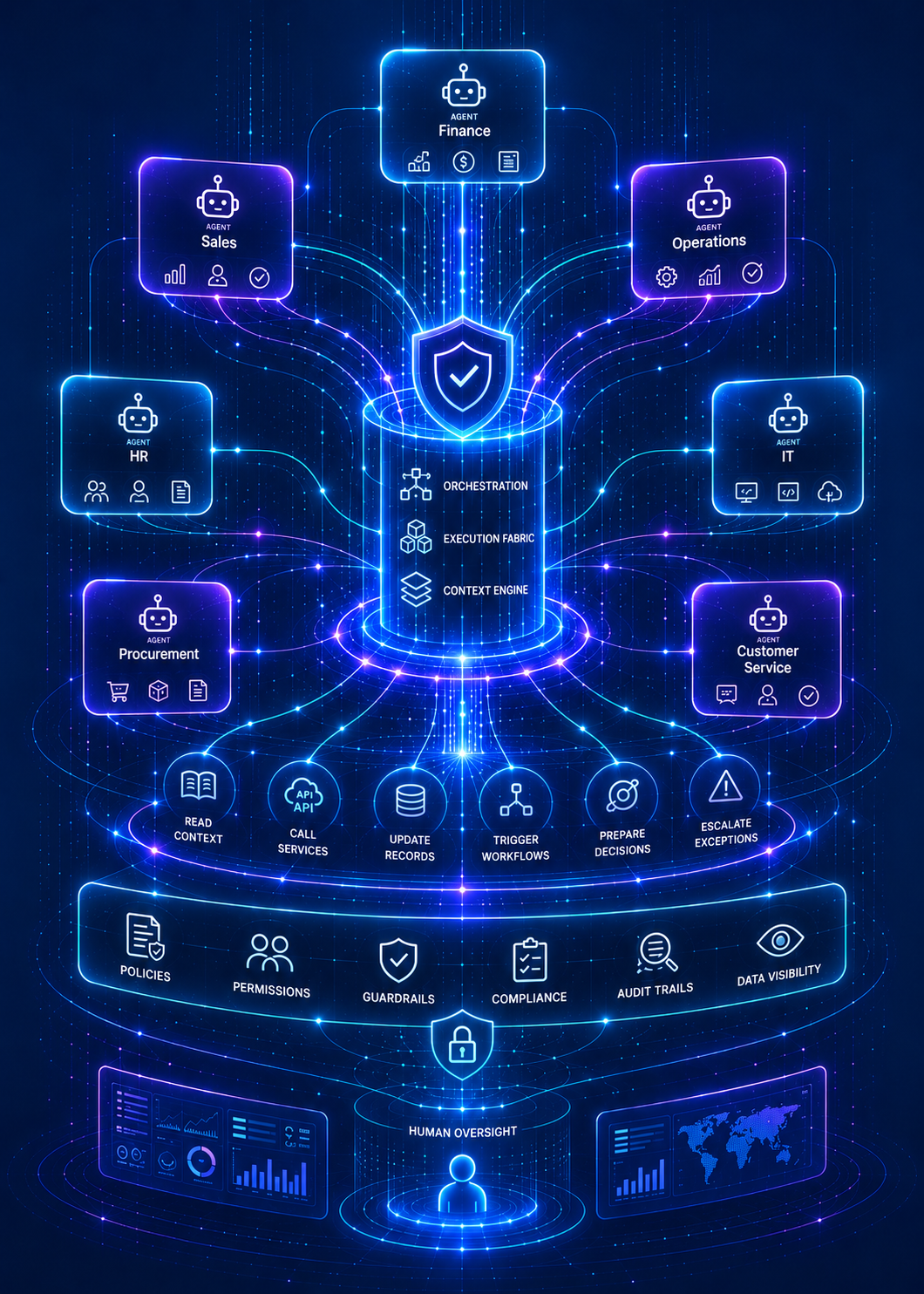
AI agents execute work inside the control model

Advanze treats AI agents as participants in the operating model. Agents can read context, call services, update records, trigger workflows, prepare decisions and escalate exceptions. Human teams remain responsible for judgement, governance and business accountability.

That distinction matters. The goal is not to add another chatbot to existing systems. The goal is to create an execution platform where work can move across functions with consistent permissions, policies, audit trails and data visibility.

Business outcomes

What becomes possible

Outcome alignmentTie workflows to measurable business objectives.
Execution velocityReduce handoffs, manual follow-up and status chasing.
Control and governanceEmbed approvals, policies and audit evidence into work.
Data-driven improvementUse unified telemetry to improve continuously.
Revenue team reviewing commercial work before customer commitment.
The outcome is not just automation. It is confidence in what happens next. When Revenue Growth runs inside a governed execution model, teams can move faster without losing judgement, accountability or trust.

Agentic use case

Where Revenue Growth becomes governed execution.

A salesperson needs to send a proposal quickly.

What makes it harder in the real world: A proposal can include pricing, discounts, delivery commitments, legal terms, billing implications, product scope and operational promises that require review before they become customer-facing commitments.

What Advanze changes: Coordinate proposal drafting, pricing validation, legal terms, margin checks, approval thresholds and customer follow-up before a sales offer is sent.

Sales Context AgentAssembles account, opportunity, prior conversations, product interest and buying stage.
Pricing AgentChecks plan, users, modules, discounts, minimum package and commercial rules.
Legal Terms AgentFlags non-standard contract language, liability concerns and approval needs.
Finance AgentChecks payment terms, margin, invoicing model and revenue implications.
Proposal AgentDrafts proposal content and next-step email with assumptions and approval notes.
Challenge

A proposal can include pricing, discounts, delivery commitments, legal terms, billing implications, product scope and operational promises that require review before they become customer-facing commitments.

Orchestration

Coordinate proposal drafting, pricing validation, legal terms, margin checks, approval thresholds and customer follow-up before a sales offer is sent.

Success

Coordinate proposal drafting, pricing validation, legal terms, margin checks, approval thresholds and customer follow-up before a sales offer is sent.

Revenue team reviewing commercial work before customer commitment.
Commercial review 12Revenue teams aligning customer, proposal, commercial and delivery context before action.
Revenue team reviewing commercial work before customer commitment.
Commercial review 13Revenue teams aligning customer, proposal, commercial and delivery context before action.
Revenue team reviewing commercial work before customer commitment.
Commercial review 14Revenue teams aligning customer, proposal, commercial and delivery context before action.

Why AI execution needs architecture

The work needs context, controls and clear permissions before automation can safely act.

That is why the Advanze control model matters: identity, permissions, policies, workflow, audit evidence and human judgement are embedded into execution before agents act.

  • A proposal can include pricing, discounts, delivery commitments, legal terms, billing implications, product scope and operational promises that require review before they become customer-facing commitments.
  • The right agent must receive the right context, tools, permissions and approval path before work moves forward.
  • Audit evidence, exception handling and human judgement need to be part of the workflow, not notes added after the fact.

Implementation path

How to move from concept to production

Advanze can be introduced progressively. The recommended path is to start with a visible workflow, prove the operating model, then expand into adjacent capabilities as the platform foundation matures.

  1. 1
    Assess the current operating model

    Map the workflows, systems, data sources and manual coordination points around this capability.

  2. 2
    Design the target execution flow

    Define the data model, human approvals, agent tasks, service calls and governance controls.

  3. 3
    Launch a focused implementation wave

    Start with a bounded use case that proves the operating pattern and creates reusable platform assets.

  4. 4
    Scale across the business

    Extend the pattern to adjacent workflows, more agents, more users and deeper integrations.

Next step

Build this into your execution platform roadmap

Explore how Revenue Growth can be implemented as part of a broader Advanze platform adoption programme, from first pilot to enterprise scale.