
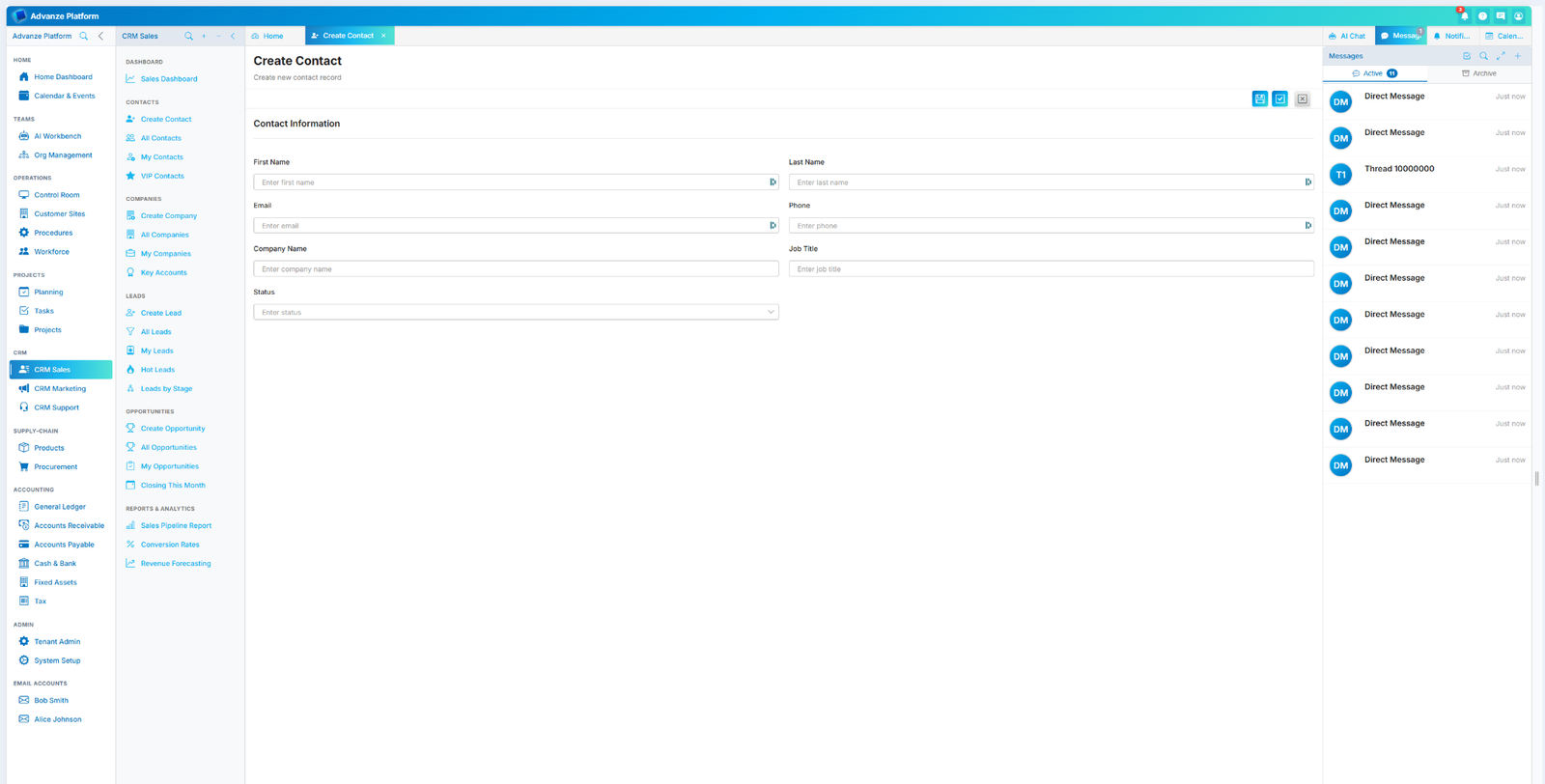
Pipeline Management
AI agents track deal progression, identify at-risk opportunities, suggest next best actions, and maintain forecast accuracy across the entire sales pipeline.
Commercial Model
A simpler way to plan adoption, consolidation and scale.
CRM Sales provides a commercial view of the Advanze platform. Pricing is designed to support consolidation, predictable adoption and a clearer relationship between platform investment and operating outcomes.

Commercial Model / CRM Sales
Advanze is positioned around the idea that enterprise software must evolve from passive systems of record into active systems of execution. In that model, this page is not just a feature description. It explains how CRM Sales contributes to an operating environment where people define intent, agents execute governed work, and leadership can see progress through unified data.
The value is strongest when the capability is connected to adjacent processes. Records, workflows, controls, communications and analytics should not live in separate tools. They should participate in a shared execution fabric that can coordinate work across departments while preserving human accountability.

Core capabilities
Each capability is designed to work as part of the broader execution platform rather than as a disconnected module.
AI agents track deal progression, identify at-risk opportunities, suggest next best actions, and maintain forecast accuracy across the entire sales pipeline.
Automated lead research and enrichment where agents gather company data, identify decision makers, assess buying signals, and prioritize outreach based on conversion likelihood.
Streamlined deal documentation with AI agents generating accurate quotes, assembling proposals from templates, and ensuring pricing and terms comply with approval policies.
Intelligent account assignment and territory planning where agents balance workload, optimize coverage, and ensure high-value accounts receive appropriate attention.
Real-time visibility into sales performance, pipeline health, win/loss analysis, and AI-generated forecasts that help leadership make data-driven decisions.
Governed sales processes for approvals, renewals, and deal progression where AI agents handle routine tasks and escalate exceptions for human review.
Agentic operating model
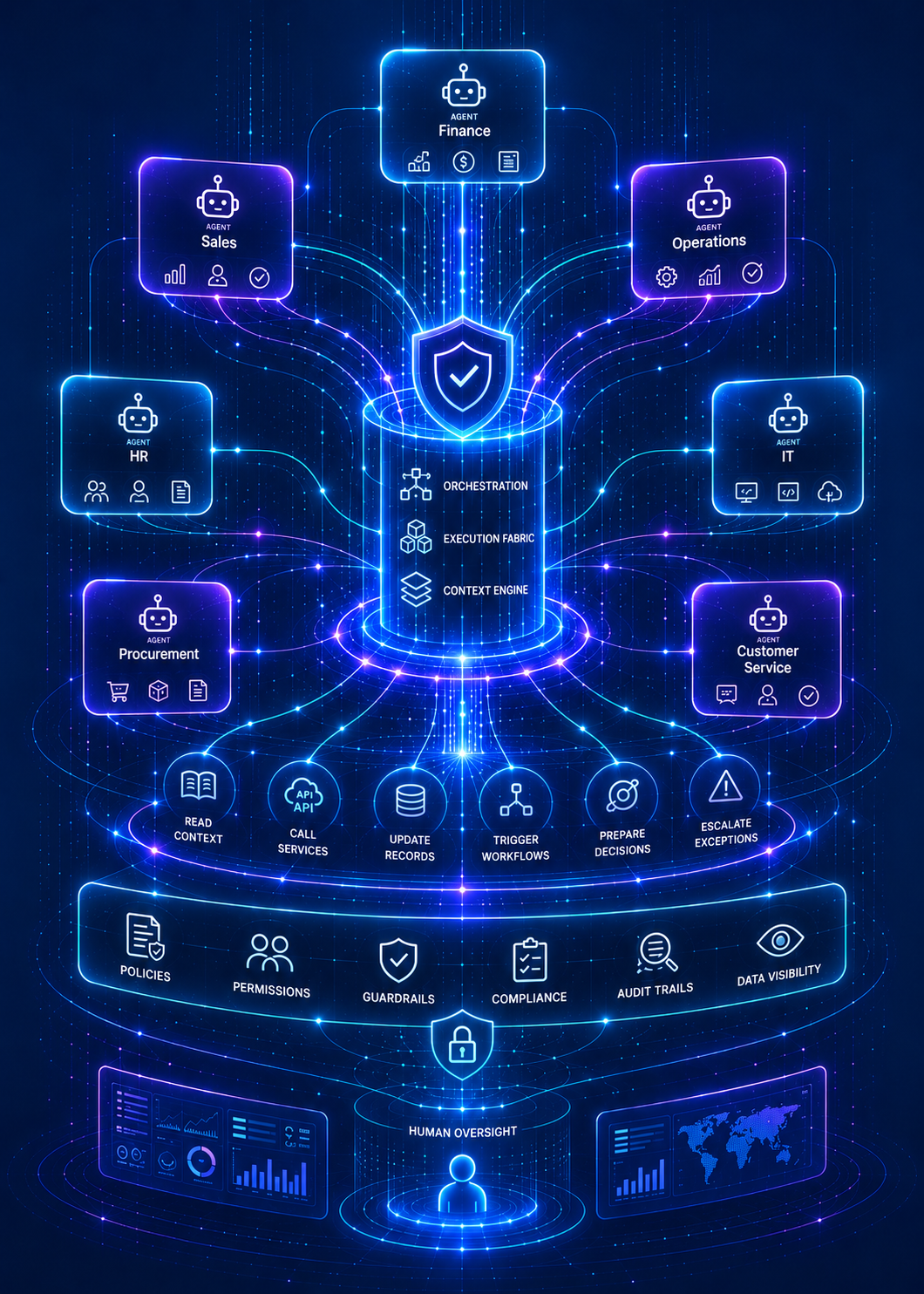
Advanze treats AI agents as participants in the operating model. Agents can read context, call services, update records, trigger workflows, prepare decisions and escalate exceptions. Human teams remain responsible for judgement, governance and business accountability.
That distinction matters. The goal is not to add another chatbot to existing systems. The goal is to create an execution platform where work can move across functions with consistent permissions, policies, audit trails and data visibility.
Business outcomes

Implementation path
Advanze can be introduced progressively. The recommended path is to start with a visible workflow, prove the operating model, then expand into adjacent capabilities as the platform foundation matures.
Identify which applications, services and integrations should be included in the first adoption wave.
Estimate consolidation savings, productivity lift and execution capacity using conservative assumptions.
Start with a focused pilot or move directly into a platform foundation programme.
Expand suites, agents and integrations with clear governance and measurement.
Why this pricing path matters
A salesperson needs to send a proposal quickly.
What makes it harder in the real world: A proposal can include pricing, discounts, delivery commitments, legal terms, billing implications, product scope and operational promises that require review before they become customer-facing commitments.
What Advanze changes: Coordinate proposal drafting, pricing validation, legal terms, margin checks, approval thresholds and customer follow-up before a sales offer is sent.
A proposal can include pricing, discounts, delivery commitments, legal terms, billing implications, product scope and operational promises that require review before they become customer-facing commitments.
Coordinate proposal drafting, pricing validation, legal terms, margin checks, approval thresholds and customer follow-up before a sales offer is sent.
Coordinate proposal drafting, pricing validation, legal terms, margin checks, approval thresholds and customer follow-up before a sales offer is sent.


Control model
That is why pricing has to connect to the operating model: the number of users is only one part of the cost; the real value comes from governed execution, reusable controls and agent work that can safely scale.
Next step
Explore how CRM Sales can be implemented as part of a broader Advanze platform adoption programme, from first pilot to enterprise scale.